(Click
on underlined link to go to subject)
- Contents
Chapter
1. Vision System Design
Chapter
2. Biological Eye Designs
A. Camera
B. Pinhole
C. Concave
mirror
D.
Apposition
E. Neural
superposition
F.
Refraction superposition
G.
Reflection superposition
H.
Parabolic superposition
I. Multiple
sensor types
and combinations of types
Chapter
3. Eye Design Illustrations
Chapter
4. Eye
Reproduction
Chapter
5. Optical
Systems Design
Chapter
6. The Eye Designer
Related Links
Appendix A -
Slide Show & Conference Speech by Curt Deckert
Appendix B -
Conference Speech by Curt Deckert
Appendix C -
Comments From Our Readers
Appendix D -
Panicked Evolutionists: The Stephen Meyer Controversy
|
EYE
DESIGN BOOK
Chapter 2
Sections D, E and F
- Prev Page
Go to Chapter
Links -
Next Page -
(Click on PICTURE IN TEXT
to bring up LARGE PICTURE)
2. BIOLOGICAL EYE DESIGN
D.
Apposition compound
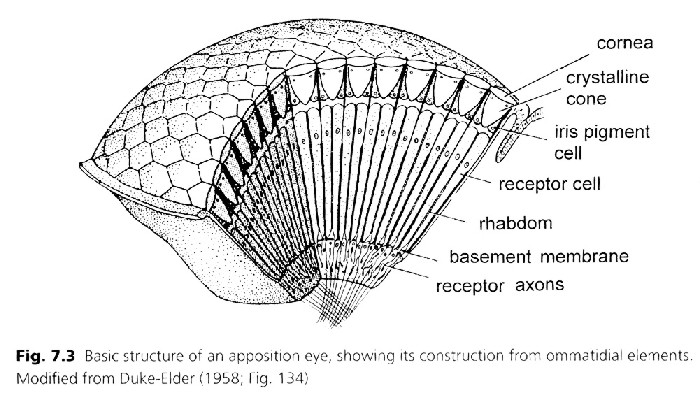
The apposition compound eye design does
not form a complete image in each facet. Each facet picks up part of the
image. It is compound because there are many facets or separate sensor
modules. It is one of the more common small eye designs. It occurs in insects
such as ants, wasps, dragonflies, bees, and cockroaches. Each of many small
facets or lenses of the eye are separate light sensors. The brain puts
each image together
by processing the output of each sensor of each small lens
facet. Each facet lens contains its own sensors to detect light from specific
angles. For small eyes, this is an extremely complex approach. Each very
small eye sensor facet or module has a lens and light pipe to gather each
part of the total image. Signals from each facet of the image are then
relayed to the brain.
One advantage of this type of compound eye
is the ability to detect movement within a partial scene while using less
brain processing time than that required to process the full image. An
advantage over camera and pinhole eyes is that they can cover very wide
fields with less total volume, because of the shortening of the optical
path of each facet. Parts of these eyes are similar to lens arrays and
new camera sensors now being developed for small advanced cameras, but
the integration of the apposition design is difficult. Figure 2.9 helps
us to visualize how these eyes are designed. (P. 359, Physiology of
Photoreceptor Organs, 1972, Ed. by M. G. F. Fuorki, Pub. by
Springer-Verlag)
(Figure 2.9a: For reference see Fig 7.3, p. 128, Animal Eyes, Michael F. Land,
Dan-Eric Nilsson, Oxford Animal Biology series, Oxford University
Press, 2002)
|
Figure 2.9 Apposition
Compound Eye Design.
Figure 2.9a Apposition
Eye Construction.
|
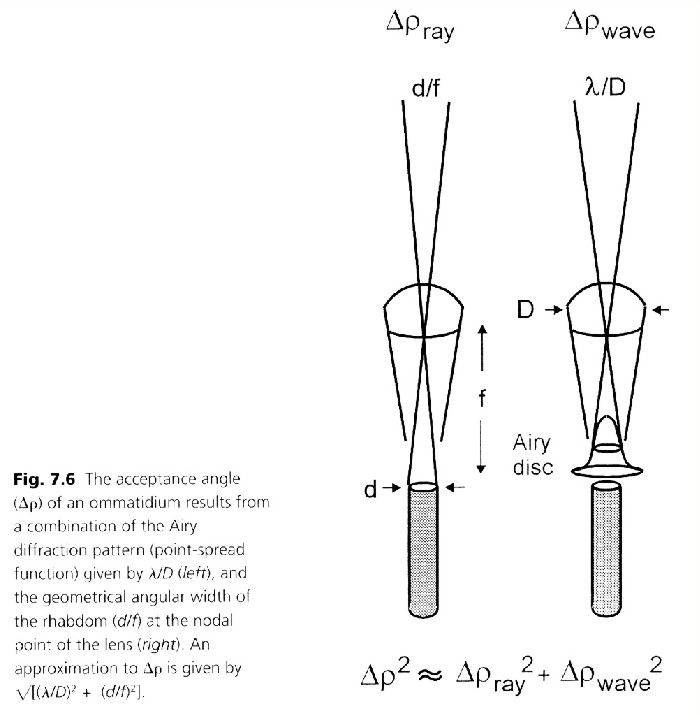
Fig 2.9b Diffraction,
Resolution, & Eye Size
(Reference: Figure 7.6, p. 134, Animal Eyes, Michael F. Land, Dan-Eric Nilsson)
|
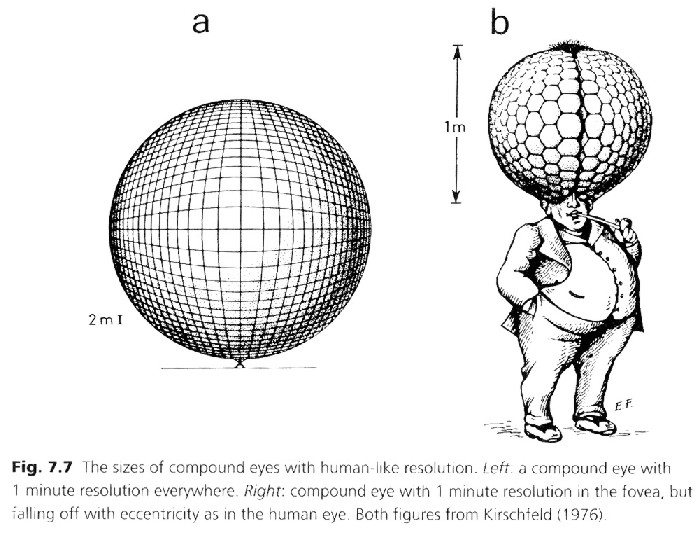
Figure 2.9c Equivalent
Compound Eye Applied
To Human Resolution.
(Reference: Figure 7.7, p. 136, Animal Eyes, Michael F. Land, Dan-Eric
Nilsson)
|
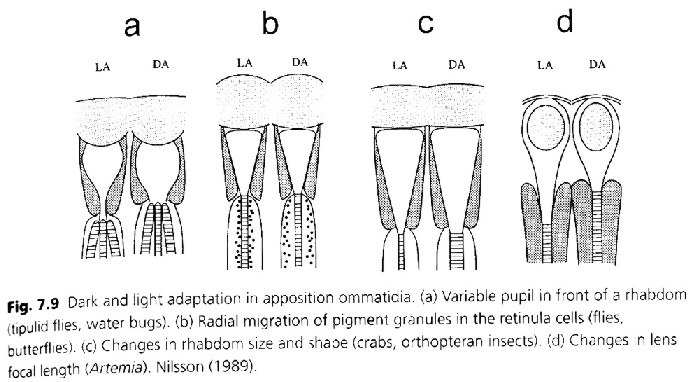
Figure 2.9e Light Adaptation
Of Compound Eye.
(Reference: Figure 7.9, p. 139, Animal Eyes, Michael F. Land,
Dan-Eric Nilsson, Oxford Animal Biology series, Oxford University
Press, 2002- Please see their book for more details )
|
An example of limitations on each
element of a compound eye is shown by the above Figure 2.9b Diffraction,
Resolution, & Eye Size
If we take the technology of a compound
eye, appearing on many insects, and applied it to the requirement for
human eyesight we would get an eye that is extremely large. Then if we
allow the resolution to fall off with angle the eye is still so large
that it would dominate the human head.This is shown on the above Figure 2.9c
Equivalent Compound Eye Applied To Human Resolution
Compound eyes have unique ways of adapting
to changing light. Many of these are quite diverse and indicate very
sophisticated design at the micron levels. The above Figure 2.9e
Light Adaptation Of Compound Eye illustrates several ways that compound
eyes adapt to light.
Some crabs use this design along with some other
optical designs such as distributed eyes. Compound apposition eyes of insects
and sea animals contain sensors within each facet. Each sensor contains
a crystalline lens and a small gradient index light pipe. The following
are examples of several creatures having compound eyes. The facets making
up each creature's eyes are shown for comparison with respect to the role
of each in creating a complete image.
| Creature |
Number of
Eye Facets |
Role
Requirements for Vision |
wood lice
small flies
lobster
dragonfly |
25
5,000
14,000
30,000 |
simple
2-dimension movement
complex 3-dimension
movement
complex 2-dimension
movement
complex 3-dimension
movement |
| Since the lens and light pipe of
each facet is very small, light may form interference patterns in these
narrow light guides. Some eyes even take advantage of wave patterns within
facets to get more efficiency. This means that small eye facets have to
be reproduced with very close tolerances for clear vision to occur. An
illustration of a dragonfly having apposition compound eyes is shown in
Figure 2.10. (P. 17 left top, Megabugs, The Natural History Museum book
of insects, Barnes & Noble, N.Y., Miranda MacQuitty with Laurence
Mound) |
Figure 2.10. Example of
Apposition Compound Eyes
|
E.
Apposition-Neural Superposition compound
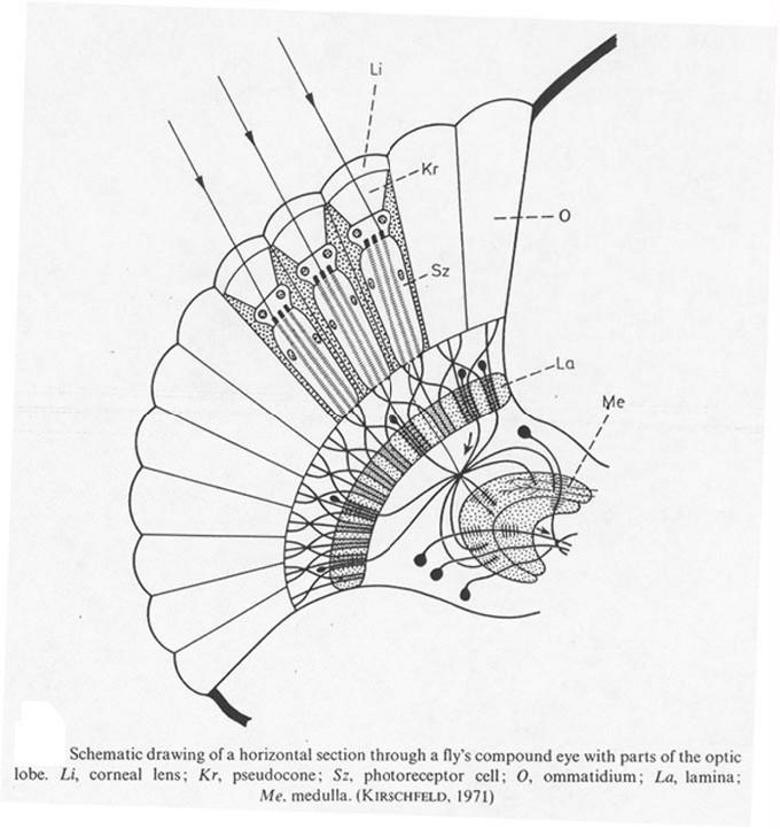
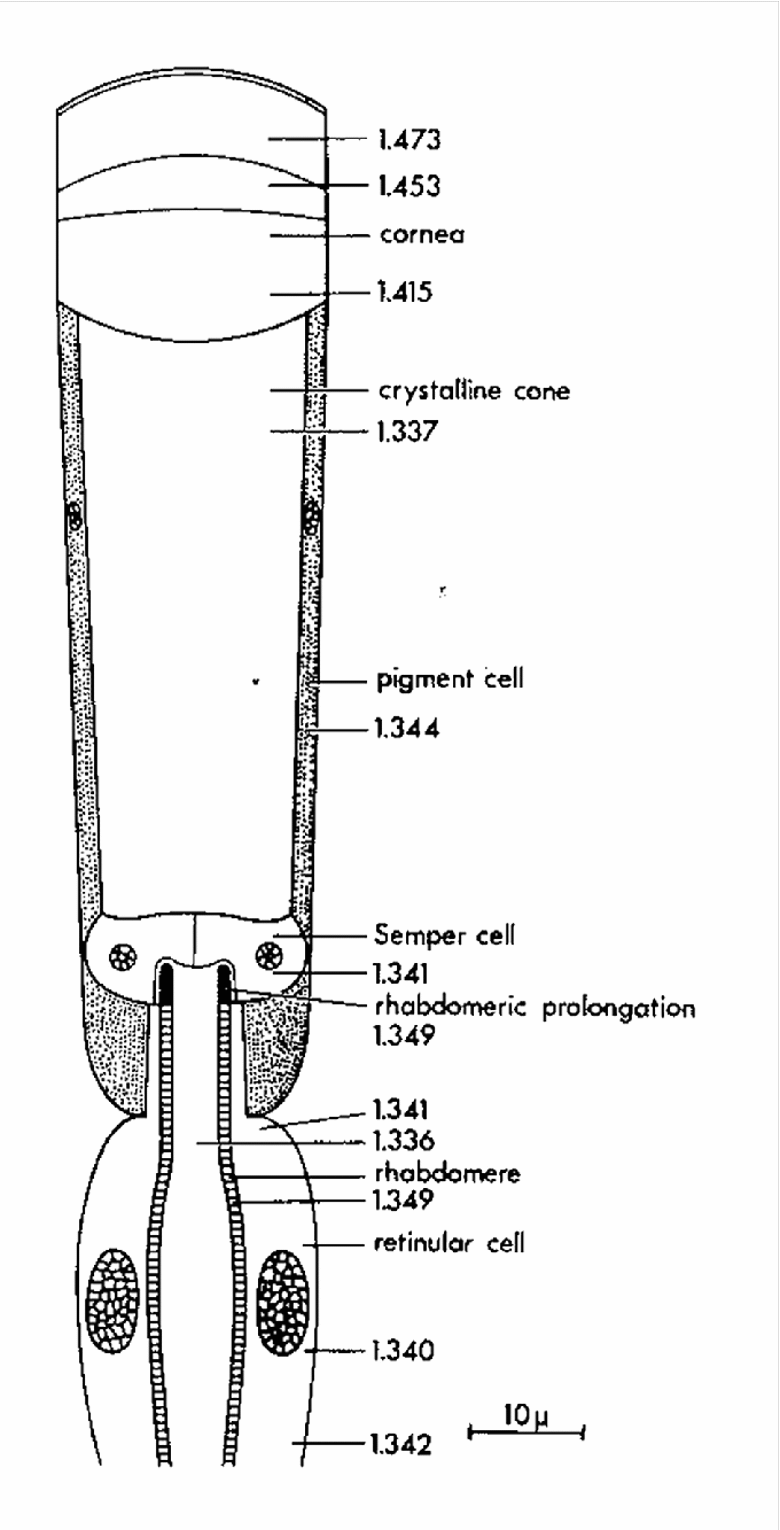
The neural or brain superposition eye has
a number of small lenses arranged in a compact pattern. Each lens collects
light from only a small part of the total field of view. Using the neural
superposition approach, the brain puts all the small images together from
the individual sensor outputs of a large number of small eye facets. Each
facet contains very small light guides and sensors. Each of these facets
or sets of sensors has its own optics and unique angular optical
axis to pick up part of a scene, but multiple facet light inputs are combined
for each segment of the image. Each segment or pixel of a scene is visualized
by a series of different sensors contained in multiple facets. Output signals
from combined facets can provide more sensitivity for better vision at
low light levels. Typically, small flies will have this type of optical
design. Where size is critical and wide-angle fields of view are required,
this design is more suitable than camera eyes for small low-resolution
applications. Figure 2.11 illustrates the slightly different optical design
of the neural superposition eye. Image processing would need to be unique
for this type of eye. Image processing is complex for any eye, but here
it is even more amazing when you consider the small brain size of flies
having this type of optical design. (p. 303, Fig. 3b,
Vision Optics
& Evolution by Dan E. Nilsson, Biosciences, Vol. 39, No. 5, May
1989)
This optical design requires considerable
parallel processing of visual data to provide image recognition with quick
response. These eyes can operate at lower light levels when they can use
the combined output from multiple facets for each point of an image to
achieve greater sensitivity. (An example of an application of the neural
superposition eye is shown in Figure 2.12 taken from Fig. 44, P.495, Chapter
8 PhotoChemistry of Vision, Ed. by Herbert J. A. Dastnall, Springer-Verlag,
N.Y. 1972. Figure 3.12b courtesy of www.pbrc.hawaii.edu/bemf
(c)MicroAngela )
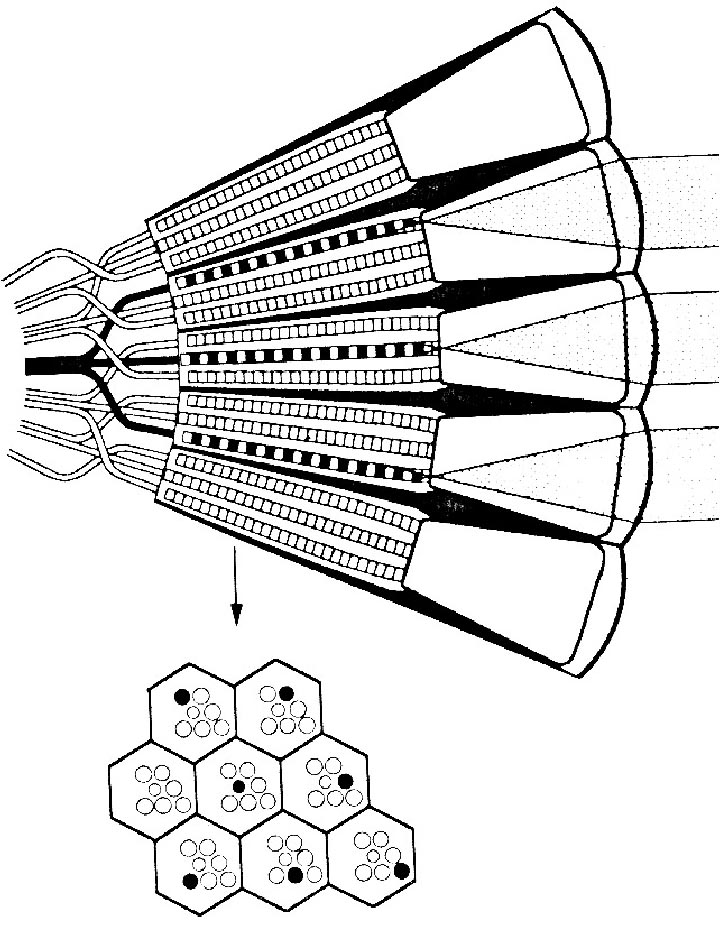
Figure 2.11 Neural
Superposition Eye.
(Like Fig. 6-5)
|
Figure 2.12a Apposition
Neural Superposition
Simplified Small Fly Eye
|
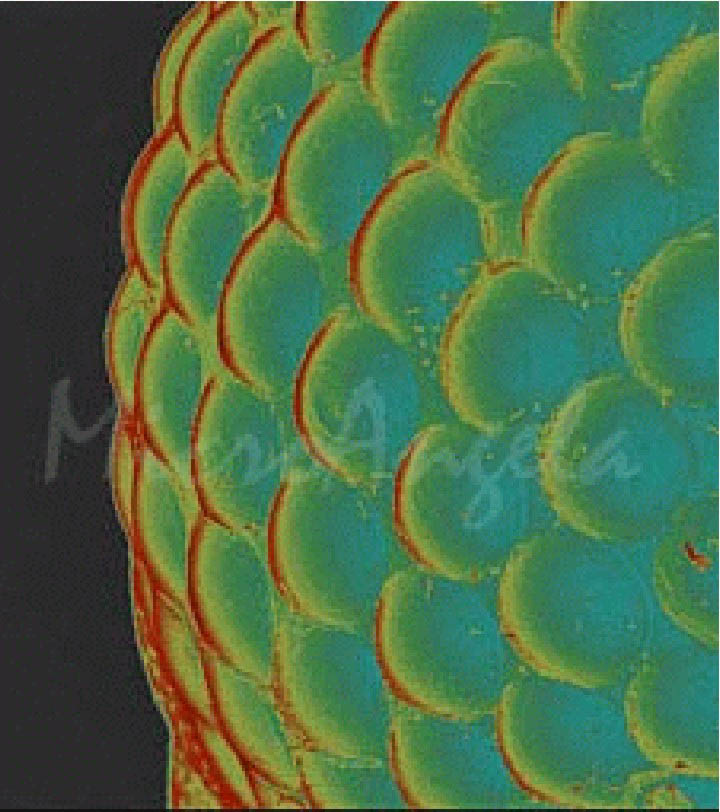
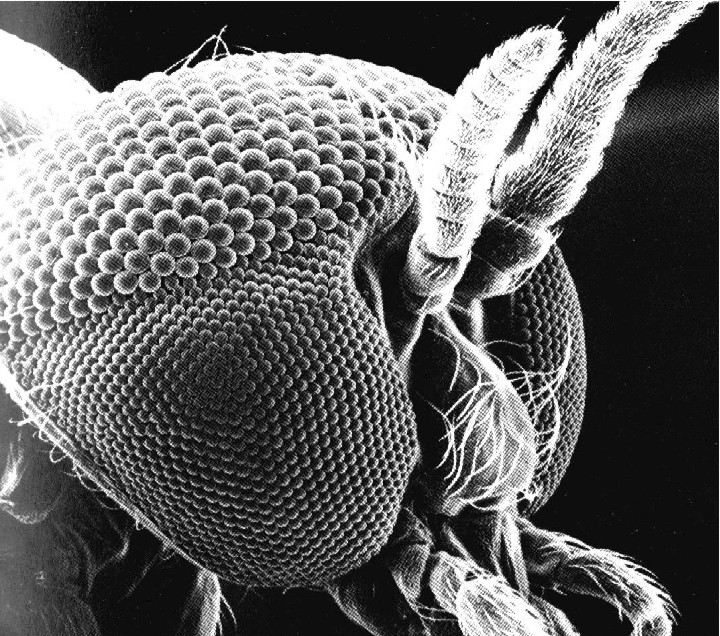
Figure 2.12b Compund
Insect Eye
|
F. Refraction superposition
compound
Like the previous design, this optical design
would also be difficult to adapt from other eye designs. These eyes occur
in moths, some flies, many beetles, and some shrimp. This optical design
may be a more difficult eye to integrate, but it does give considerable
design flexibility for small insect vision. It is a design where an array
of clear refractive (or transmitting) crystalline cones work together as
telescopic optics to produce a reversed image on a very small retina.
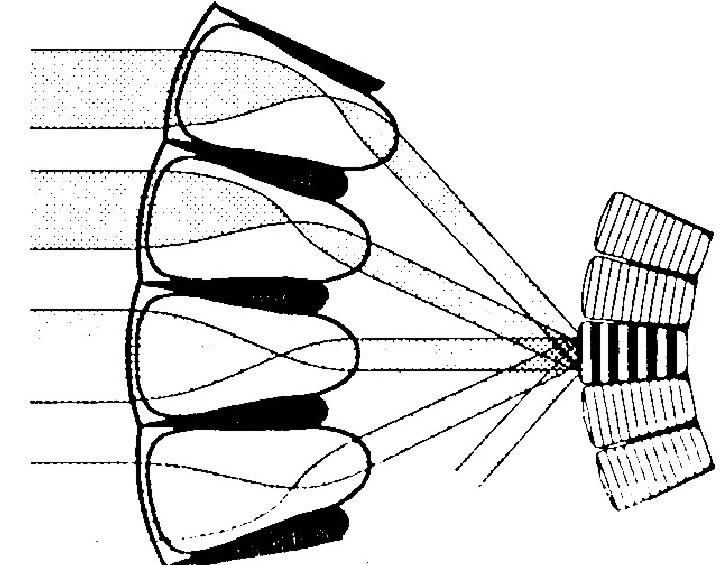
Figure 2.13 Refraction
Superposition Eye
|
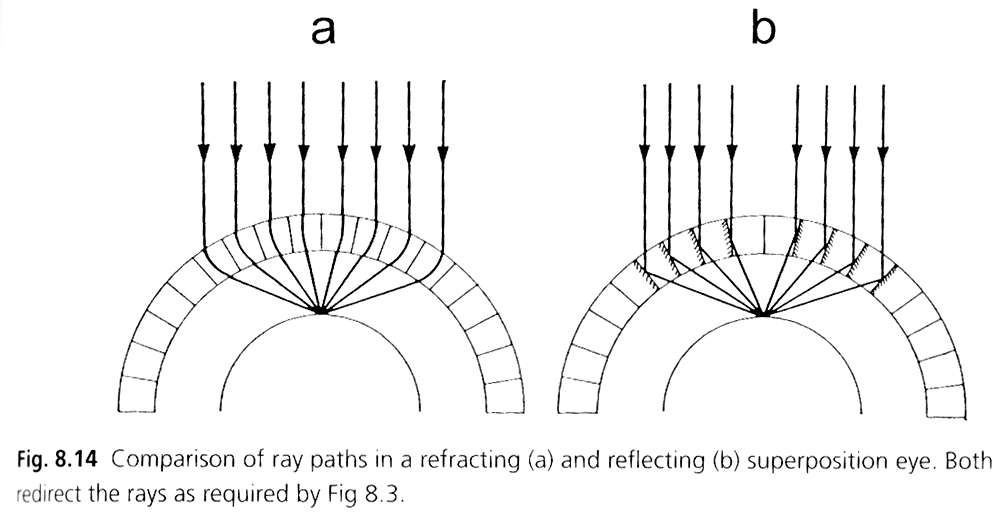
Figure 2.13a Reflective
Superposition
(See Figure 8.14, p. 173, Animal Eyes.)
|
Figure 2.13b Reflective &
Refractive Superposition (See Figure 8.14, p. 173, Animal Eyes.)
|
(Figure 2.13 illustrates the refraction superposition
optics techniques is from p. 303, Fig. 3c, Vision Optics &
Evolution by Dan E. Nilsson, Biosciences, Vol. 39, No. 5, May 1989.
For more details on figures 2.13a and 2.13b Refer to Animal
Eyes, Michael F. Land, Dan-Eric Nilsson, Oxford Animal Biology
series, Oxford University Press, 2002)
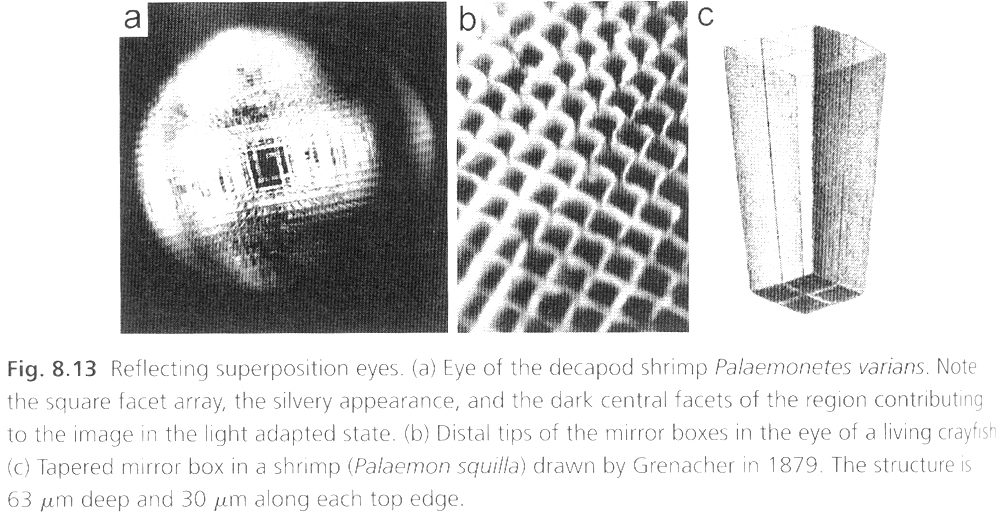
The intricate detail of reflective superposition
eyes is shown on the above Figure 2.13a Reflective Superposition Example.
Current MEMS technology can allow some fabrication of similar structures
and optics, but the processing features indicate software intelligence
that is very significant for the size of the brain interpreting the input
from the eyes.
Two different approaches to Superposition Eyes
are shown in the above Figure 2.13b Reflective And Refractive Superposition.
The refraction superposition
compound optical design is similar to gradient
index lens arrays, which are currently used to replace conventional lenses
where optical distances are very short and where broad field coverage is
needed. Gradient index lenses can greatly reduce the optical path of an
optical system where an upright image is required. Like very small arrays
of lenses, gradient index material allows imaging over short distances.
Here facets may not require precise spherical surfaces. Images are corrected
by light being bent by very repeatable radial variations in the refractive
index of the light guide material within each facet. These arrays of gradient
index facets refract light much like an array of small lenses.
Gradient index material occurs in many natural
eyes. Control of repeatable radial material variations at the cell level
is required to make functional imaging systems. There is very little probability
of gradient index cell arrangements occurring randomly in eye facets without
considerable intelligent control. Each facet forms the equivalent of a
small Kepler telescope that contains the equivalent of two lenses to make
the image upright. Figure 2.14 shows several examples of refracted super
position. (Fig.2.14 is from P. 97 left top, Megabugs, The
Natural History Museum book
of insects, Barnes & Noble, N.Y., Miranda MacQuitty with Laurence
Mound. Fig. 2.15a is from Fig. 12, P.459, Chapter 8 PhotoChemistry
of Vision, Ed. by Herbert J. A. Dastnall, Springer-Verlag, N.Y. 1972)
Figure 2.15b Representative
Superposition Eye Section
(For details see Figure 8.1,
p. 156, Animal Eyes,
|
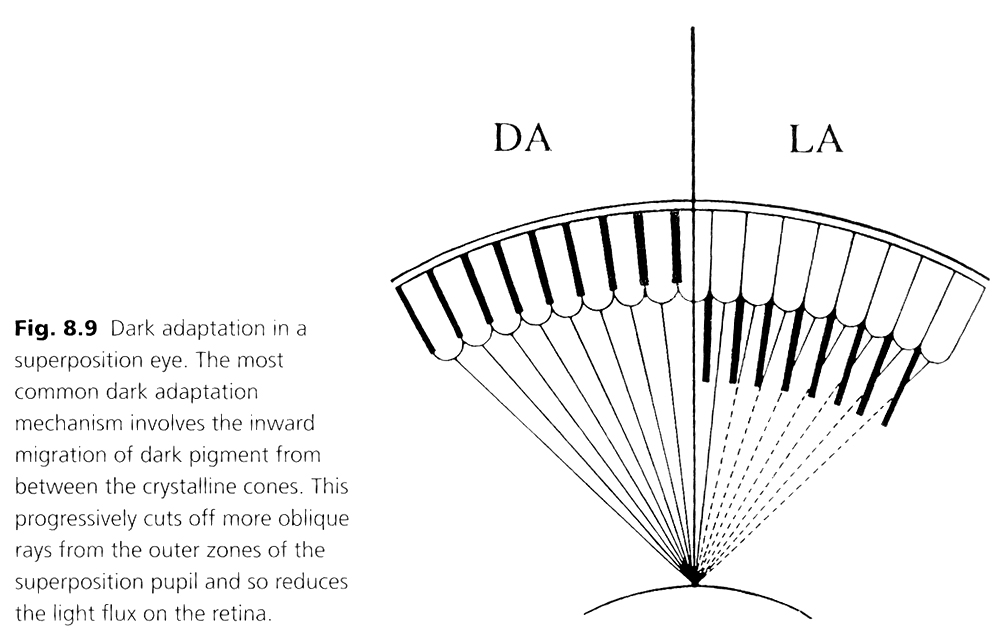
Figure 2.15c Superposition Eye Dark Adaptation Methodology
(For details see Figure 8.9, p. 165, Animal Eyes).
|
|
Figure 2.14 Refracted
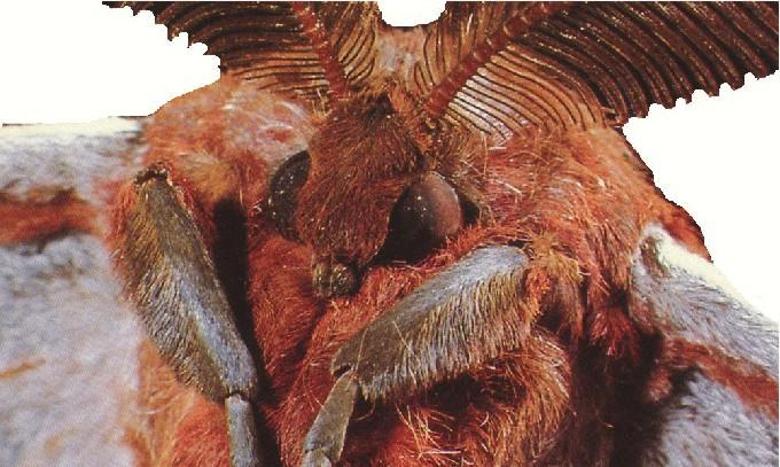
Superposition Moth
Eye with a large number of
facets (Like Fig. 3-21)
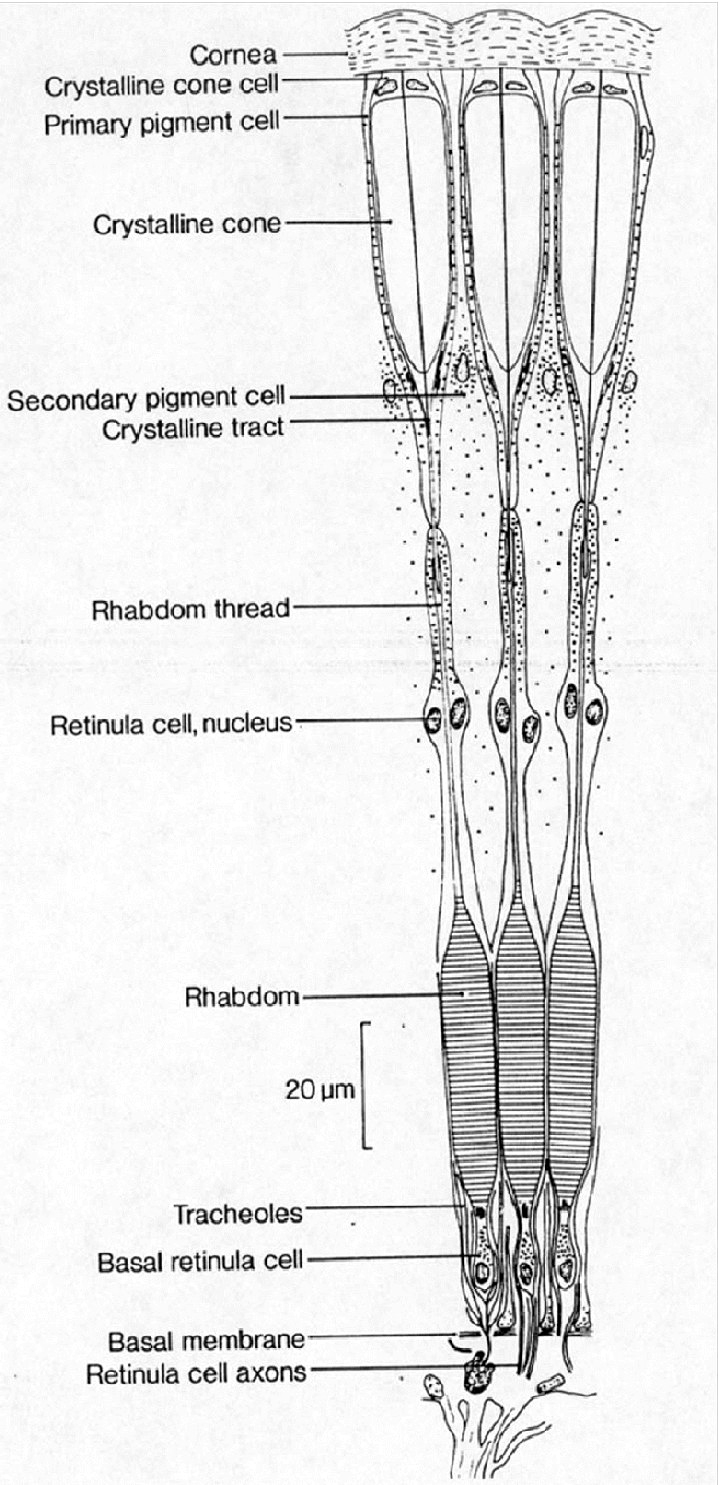
Figure 2.15a Detail of Moth
Eye Facets
|
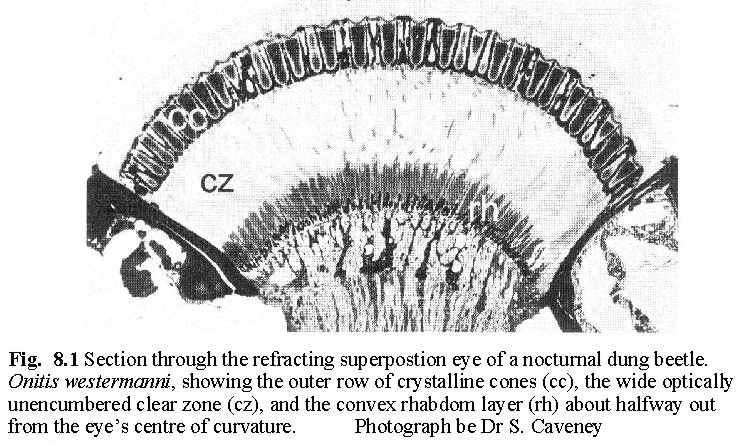
The above Figure 2.15b shows a section
of a superposition eye. It indicates
very complex approach that some optical designers have tried to emulate.
There are many applications for optical systems of this type, if they
could be replicated economically. Such an optical system can be built
in a very small volume. This type of eye allows small insects and some
larger animals to have a wide field of view.
The above Figure 2.15c illustrates how the superposition eye adapts
to various levels of light.
(Reference: Animal Eyes, Michael F. Land, Dan-Eric Nilsson,
Oxford Animal Biology series, Oxford University Press, 2002- Please
see their book for more details )
Questions for Discussion
Do you wonder, like
I do, what has controlled the design of eyes |
|