(Click
on underlined
link to go to
subject)
- Contents
Chapter
1. Vision
System Design
Chapter
2. Biological Eye Designs
Chapter
3. Eye
Design Illustrations
Chapter
4. Eye
Reproduction
Chapter
5. Optical
Systems Design
A.
Introduction
B.
Manufactured optics
1. Astronomy
and
surveillance
2. Stable
platform for
optical systems
3. Robotic
camera
applications
4. Flying
robotics
5.
Microscope
and
endoscopic applications
6. New
technologies to see building blocks of cells
C. Present
vision system technology approaches toward artificial eye development
D.
Integration of mans technology with
biological eyes
Chapter
6. The Eye Designer
Related Links
Appendix A -
Slide Show & Conference Speech by Curt Deckert
Appendix B -
Conference Speech by Curt Deckert
Appendix C -
Comments From Our Readers
Appendix D -
Panicked Evolutionists: The Stephen Meyer Controversy
|
EYE DESIGN BOOK
Chapter
5
Sections A and B
-
Prev Page
Go to Chapter Links
-
Next Page -
(Click on PICTURE IN TEXT
to bring up LARGE PICTURE)
5. OPTICAL SYSTEM DESIGNS
LEADING TO ARTIFICIAL EYES
A.
Introduction Present machine
vision systems are very limited in overall capability as compared to most
biological eyes. Comparing eye-type optical systems in the 1990's with
nature's eyes is much like the Wright brothers' aeronautical science being
compared to spacecraft of the late 1990's. As we learn more about biological
eyes, we understand they have specific cell designs, not random chance
mixtures of elements.
In the following sections we will consider optical systems that may
be foundational in developing technology to design and build special purpose
“eyes” that approach the capabilities of those found in nature. Reproduction
and continuous repair of nature’s eyes are far ahead of the complex optical
systems man has designed. Since the living cell structure is dynamic, the
repair function that goes on in the eyes' retinas is more advanced than
any adaptive image sensor man has been able to design.
B. Manufactured optics
As recently as several centuries ago, the
wide spread use of lowest commercial optics such as lenses and mirrors
was limited. The earliest commercial uses of optics were, of course, eyeglasses,
magnifiers, mirrors, telescopes, and microscopes. After hundreds of years
of optical component design and production, there are now a wide variety
of commercially available optical building blocks with many choices of
materials, and technologies for the development of new optical systems.
As optical industries developed, manufacturing technology and efficiency
enabled lower cost optical products, thereby increasing their use. Optics
in television and motion picture industries gave entertainment to the world's
population.
Early attempts to duplicate the eye's function
of capturing images were limited to film cameras, which have been around
for more than 150 years. As we all know, film cameras can only sense a
limited number of frames or pictures, which have to be processed or developed.
But video cameras, which have only been around since the 1940's, can sense
a large number of scenes for recording on tape, disk, hard disk or other
computer memory. These scenes can be transferred directly to a computer
for image processing. Processing of electronic image information in a computer
requires sensors, interface electronics, and software for recognition for
what we may define as useful vision. During this century, scientists and
engineers have made increasingly determined efforts to understand eyes.
The software and hardware for man's vision system did not just appear,
but required intelligence to develop.
Have we really
come very far in attempting to duplicate eyes?
We are just scratching the surface of total
biological eye technology. There are many layers of information we have
not even penetrated. In trying to equal the size and function of the eyes
of nature, the size of video cameras, computers, and electronic components
has been greatly reduced. Image processing software and hardware has come
closer to simulating eye functions, but these innovations are only small
preliminary steps toward significant artificial eye design and developments.
During the last 20 years, high-speed micro-circuitry, sensor arrays, arrays
of micro lenses, gradient index materials, special glasses, and plastic
optics manufacturing techniques are starting to give us more suitable building
blocks for artificial eyes. These components are still limited to "non-living",
"non-reproducible" optical systems approaching the size of eyes we find
in nature.
The big challenge of optical products is to
be affordably priced to reach large international markets. Most current
attempts at creating eyes are very simplified and less versatile when compared
to biological eyes that are constantly reproduced from a variety of cell
types from generation to generation. When living eyes are compared to man's
ability to design optical systems that repair damaged building blocks,
we learn that living eyes are far advanced.
1.
Astronomy and surveillance
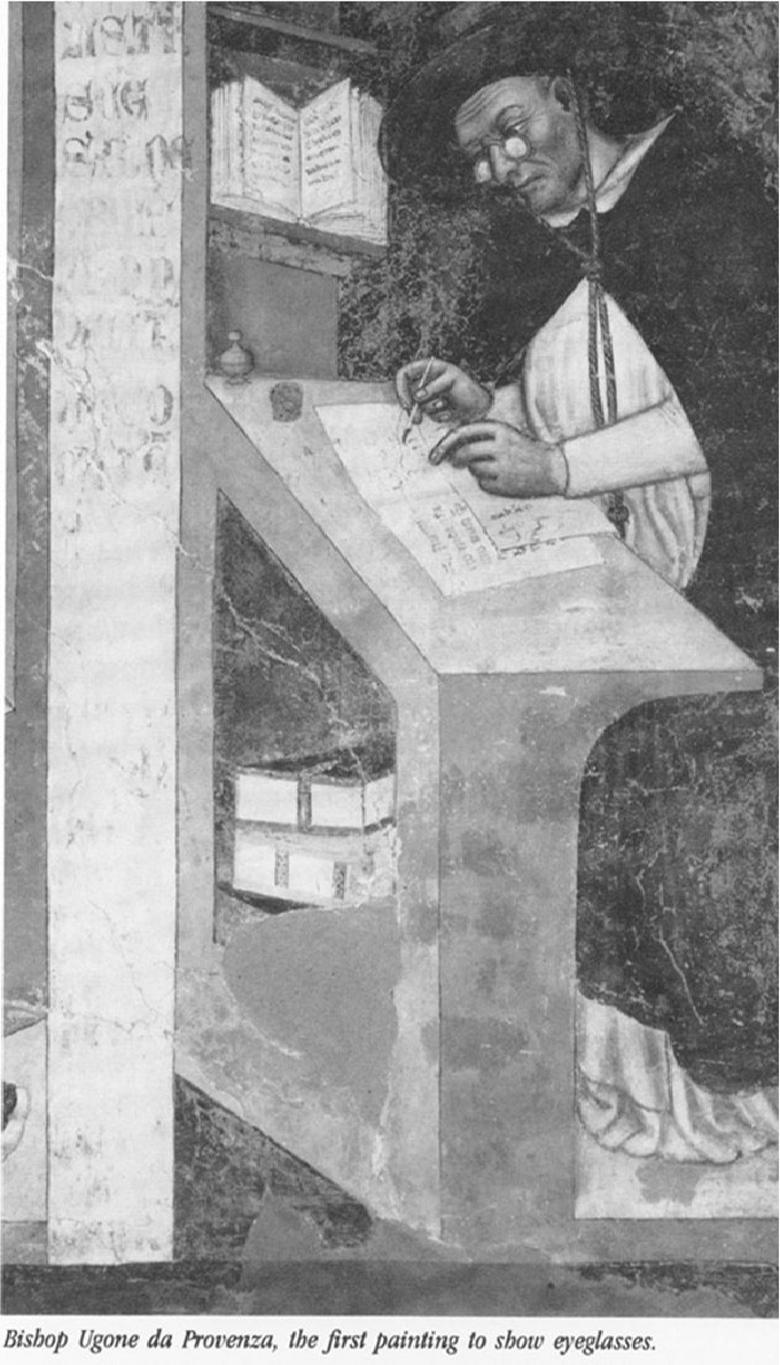
Magnifiers were developed around the 10th
century while eyeglasses were developed around the thirteenth century.
Telescopes, using simple optics to obtain magnification over a limited
field of view, were still rare in the seventeenth century while eyeglasses
were becoming more common. Telescopes were further developed during the
next century for more serious astronomy and military surveillance. Optical
development then accelerated duringthe Nineteenth Century.
Scientific and military optics developed during the Twentieth Century have
helped drive down costs. Before and during World War II, there were very
few significant optical surveillance developments that were related to
functional eye design. Now many individuals can afford eyeglasses, telescopes,
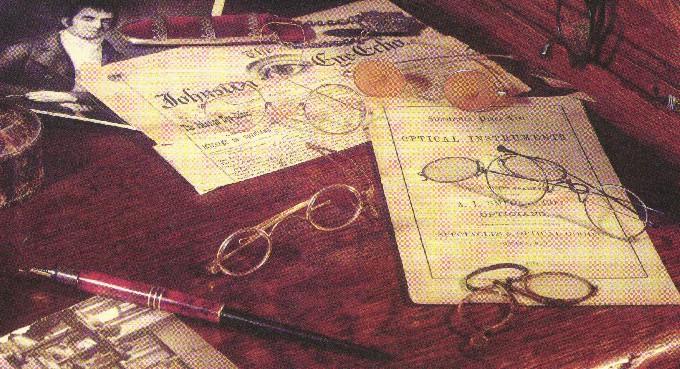
binoculars, or microscopes. The following are some illustrative optical
designs developed over seven hundred years. The first picture is from approximately
1252. (Fig. 5.1 from Pg. 20 and Fig 5.2 from Pg. 1, Looking Back - An
Illustrated History of the American Ophthalmic Industry, by Joseph
L. Bruneni, 1994 - Optical Laboratories Association)
Before the 1940's, large telescopes were reserved
for large schools, industry, and the military, because of their high cost.
The present cost of telescopic systems over five inches in diameter is
such that many people can now afford them. The same can be said for early
high-powered microscopes. As compared to instruments available during the
age of Darwin, now many people can afford to study both the huge heavens
as well as our tiny cellular building blocks because of new cost-effective
optical system developments.
Infrared and ultra-violet surveillance systems
have been developed to work beyond normal human visual capability. These
systems were used for offensive and defensive night fighting during the
1980's and 1990's. The were also used for flame detection, finding losses
of energy in power systems, finding people in burning buildings, optical
surveillance, astronomy, and biological studies.
Night vision systems were used effectively
in the Gulf and other military operations during the 1990's. Modern infrared
and ultra violet research optical systems can see more than we do with
natural human image systems. Man-made infrared optical systems need special
materials for optical transmission and low-temperature cooling, for good
sensor response. Low temperature cooling used for current IR sensors is
not needed by animals having IR vision to see targets with very little
heat radiation. Cooling requirements make the overall vision system size
differences even greater, between small natural and larger man-made IR
vision systems. Some of man's evolutionary designs lead to commercial designs
while most are not produced. Now we can display this information directly
on the retina with a very small display.
Design studies of insect eyes with UV capability,
and snakes with IR capability, will undoubtedly provide further insight
into new technologies for the development of more useful and compact optical
systems. Ultra-violet systems also require special materials to transmit
short wave length light. Different optical materials are required by insects
to see UV.
|
Figure 5-1. Historic Optics
Figure 5-2. Historic Optics
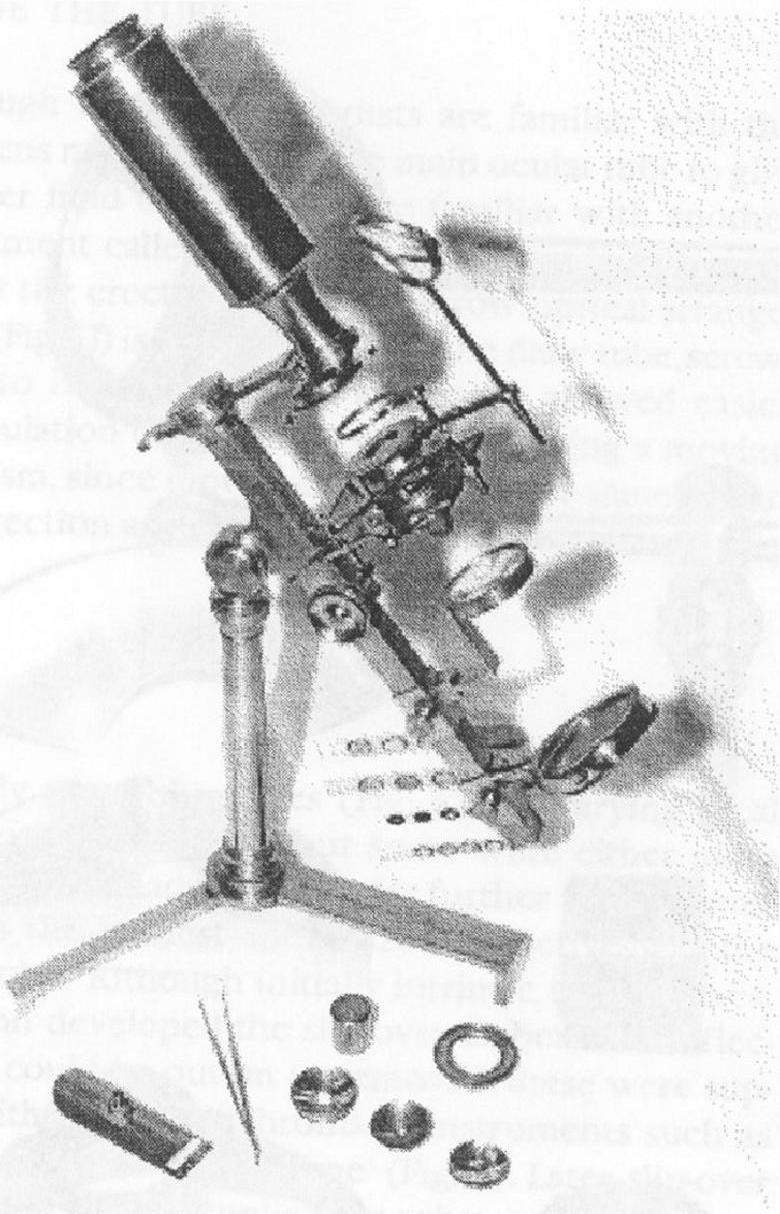
Figure 5-3. Historic Optics -
Early Microscope
(from the Journal of The
Microscopical Society of
Southern California)
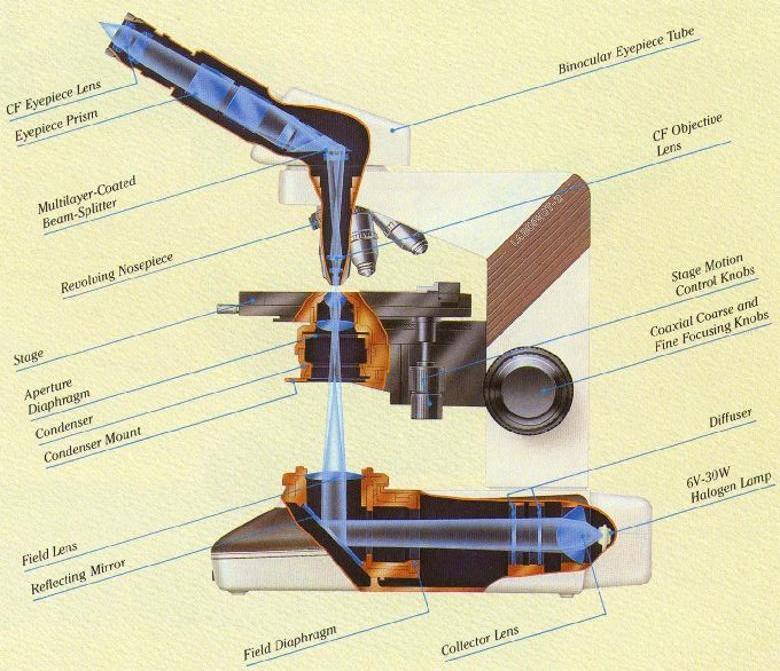
Figure 5-4. Modern Optics -
Typical Microscope Design
(Nikon LaboPilot-2, Microscope
Brochure, 2CEMXL2)
|
2. Stable
platforms for optical systems
Many of the large camera systems built for
advanced study of space and for strategic military surveillance have very
narrow fields of view. Man-made space camera systems that record movement,
scenes, or events, generally require precision scanning and tracking ability.
Vision systems are specifically designed to function from ground, ships,
aircraft, and even satellites. Suitable platforms require different mountings
and interfacing to be useful. Biological tracking systems are often taken
for granted. Eye control design requires significant programming which
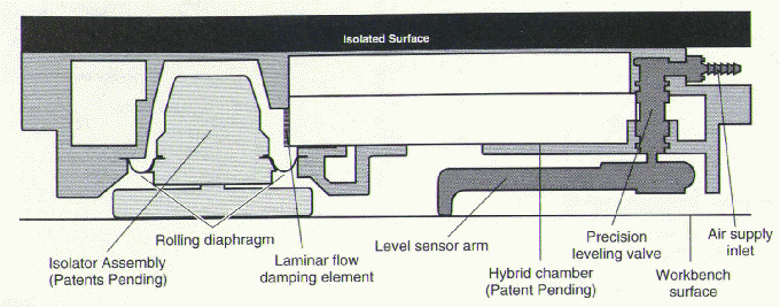
requires many parallel brain interactions. A simple stable platform for
optical equipment is shown on Fig.5-7. (Optical Equipment 2000 Catalog)
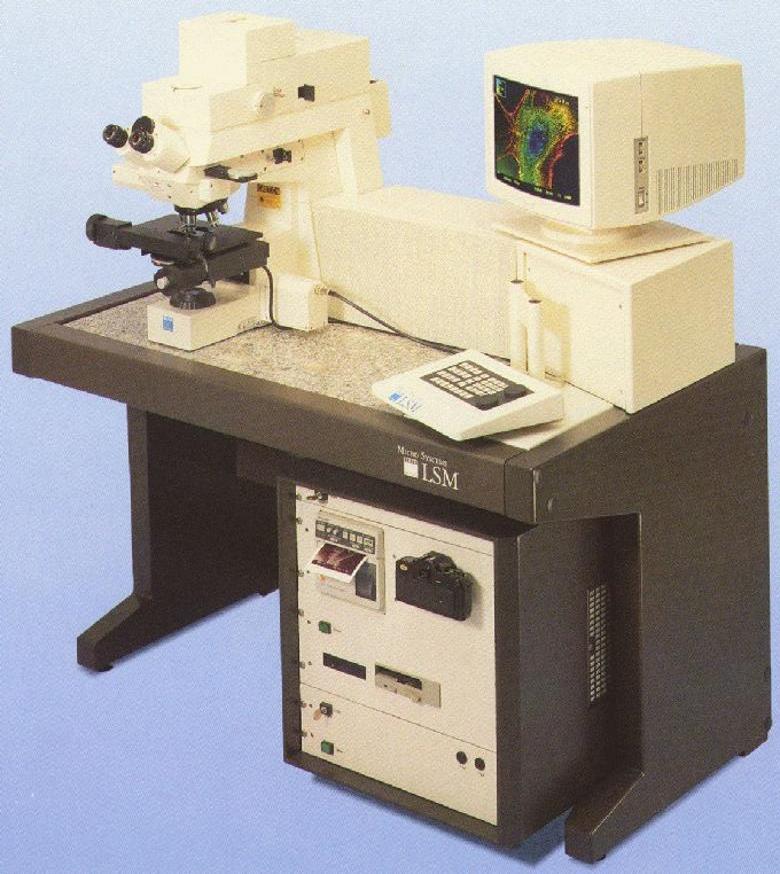
Figure 5-5. Modern Optics Confocal Laser Scan Microscope
(Zeiss
Instrument, about 1998)
|
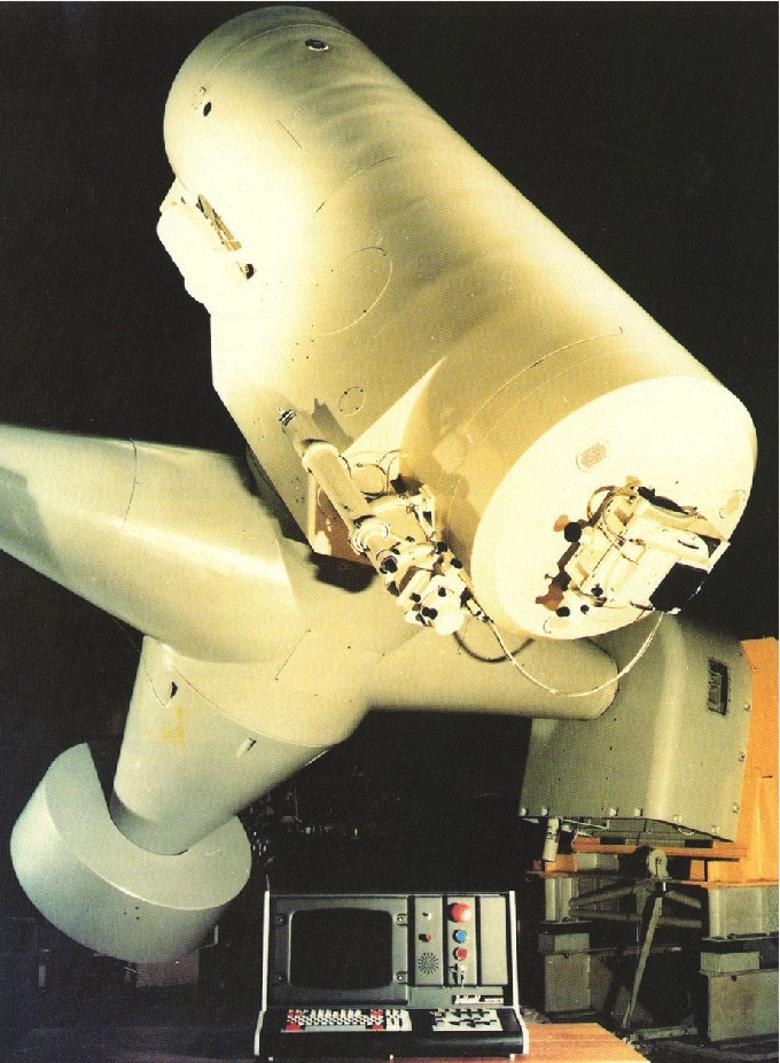
Figure 5-6. Modern Optics- 1m Mirror telescope (Pg. 47,
Zeiss Instrument, No. 2, 1992-1993, Instrument No. 12)
|
Some satellite systems can track
other satellites. Typical surveillance satellite cameras use high-resolution
electronic cameras to sense and record details from the surface of the
earth, and then electronically relay these pictures to earth. It took considerable
analysis and design effort to conceptually evolve these intricate vision
systems and their supporting platforms from the early types that dropped
film to aircraft, to those that were able to transmit complex images. This
illustrates the requirement for intelligence in biological eyes. Typical
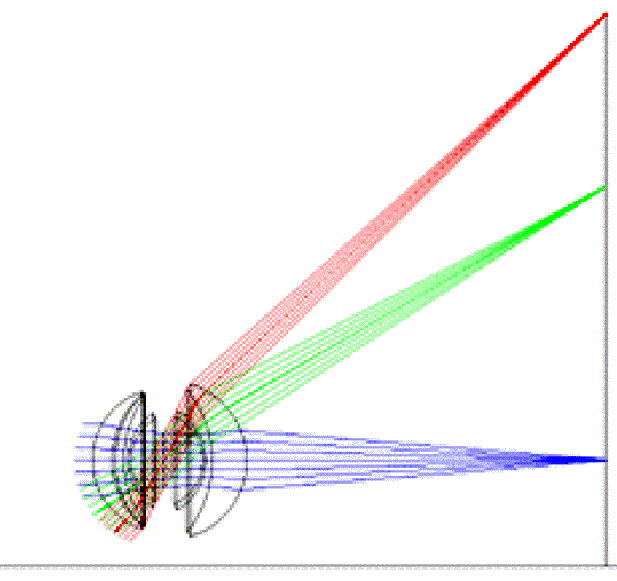
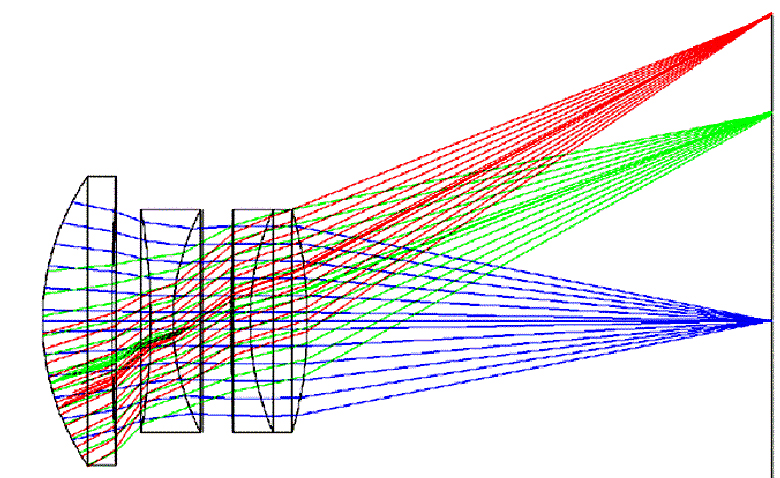
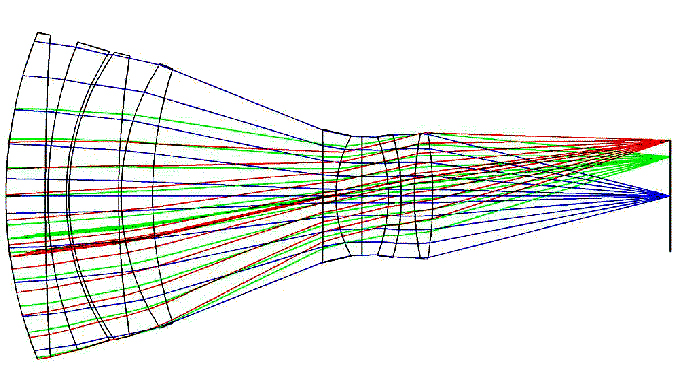
camera optical designs are shown in the following optical diagrams. (By
Curt Deckert)
Useful magnification by a telescope
for a given aperture is limited by light diffraction. Information on diffraction
limits can be found in many optical texts. The larger the aperture of a
high-quality diffraction limited telescope, the more it can theoretically
resolve. Space telescopes, operating on platforms beyond the dense atmosphere,
have optical apertures large enough to enable us to see into space much
farther than man has ever been able to see from the surface of the earth.
|
Figure 5-7. Stable Platform
for Optical Systems
(Newport Research)
Figure 5-9. Typical Meniscus
Camera Lens Optical Design
|
Figure 5-8. Typical 3 Element
Camera Lens Optical Design
|
Figure 5-10. Typical Telephoto
Camera Lens Optical Design
|
Thus, beyond the light-absorbing atmosphere,
we are witnessing the development of new science to describe our universe.
The Hubble telescope is a prime example of
a large telescope camera in space that is providing facts for updating
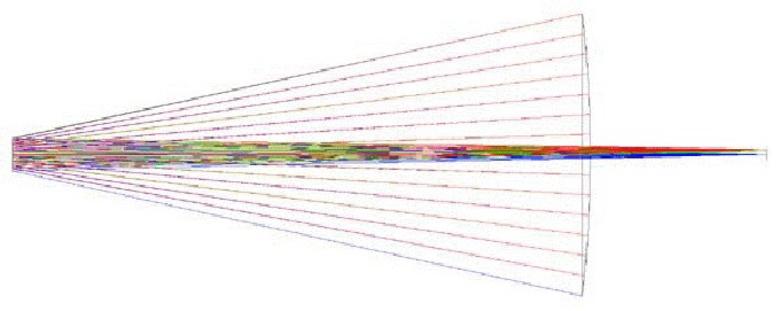
present scientific theories. See Figure 5-11 for an optical diagram of
the telescope. Many additional optics are used for the instrumentation
it supports. It works in visible, IR, and UV spectral regions and is not
limited by atmospheric interference. necessary to form biological eye optical
designs. (ZMAX Demo Program Illustration)
|
Light comes from left side and
bounces off of the large curved mirror before it comes to a focus on the
right side. Scientific theories change with new optical developments, as
we gain more insight into the world of cell functions including the eye
vision platform. This broadens the scientific foundations of artificial
optical design.
|
Figure 5-11 Hubble telescope
Optical Diagram
|
As we understand how to build more advanced optical
systems, we learn to appreciate the wide
variations in eye technologies related to biological optical systems. Here
we can start to comprehend the complexity and variations of the cells
3. Robotic
camera application
Early remote robotic camera systems were developed
to handle hazardous devices and substances. This became necessary during
the time nuclear energy sources were developed in the 1940's. These remote
handling systems were direct mechanical devices using mirrors and/or windows
to see from isolated viewing areas. As motor drives and TV cameras with
special optics were added to mechanical systems, technicians were able
to work farther away from hazardous substances, while having as much control
remotely as if they were very close.
Machine vision system containing small video
cameras, or other sensors, and computer controller systems has been used
since the 1970's. Now machine vision technology is using low-cost, high-resolution
multicolor video cameras, special lighting, high-speed computers, and special
computer software, for complex recognition purposes. As a result of these
developments, many workers who previously were exposed to chemical hazards
have been replaced or supplemented by robotic systems. These are examples
of conceptual evolution by intelligent selection.
|
Typical visual systems for robotic application
are much less versatile than the eyes of
living creatures. Man-made robotic systems often need specially
structured lighting, special optics, or color filtering in order to function
for even very limited applications. Biological systems make use of variable,
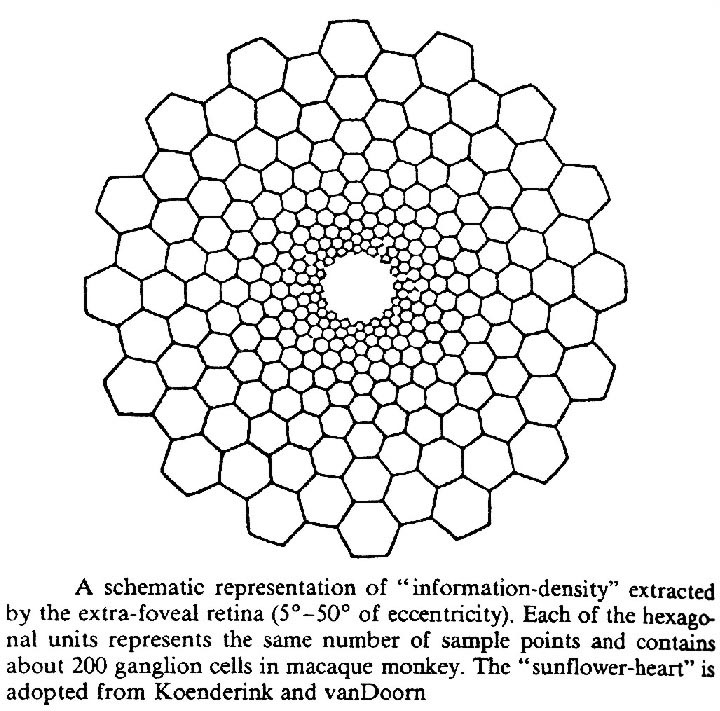
but optimized density pattern of sensors. For example see Fig. 5-12 for
an illustration of how resolution fall off from the center of vision of
a monkey, like many other eyes. This certainly indicates an intelligent
design approach to optimizing the visual usefulness of the final output
of the retina. It also takes into account the useful information coming
from the optical system. (Pg. 188, Neuro-Vision Systems, Ed. by
Madan M. Gupta, George K. Knopf, IEEE Press, 1994) |
Figure 5-12 Diagram showing
concentration of information
near the center of the eye
|
|
Advanced remote robotic systems
are now being used for surgical procedures using 3-D virtual reality and
the proper robotic instrument interfaces. The intelligence required for
design of these optical systems and to program a computer to recognize
specific subjects in a variety of remote environments is similar to that
required for natural vision systems which have been scaled down in size.
Here is a diagram of an advanced robotic neural vision
system developed at the University of Houston. (Pg. 338 SPIE Selected papers
on Model Based Vision - Vol. MS72, by R. T. Chin & C. R. Dyer)
|
Figure 5-13. Neural Robotic
Vision System Diagram.
|
Animal eyes and brains are small and compact,
compared to typical man-manufactured robotic camera and image processing
systems, but they have many of the same characteristics. One can equate
overall size to the level of technology. Smaller components such as computer
processor chips require higher technology. The higher the technology, the
greater the need for intelligent design for engineering and integration
with the environment. Present intelligent robotic systems may approach
the optical capability of a honeybee's vision system, but not its small
size, due to the bees' bio-molecular design. For example, many small bees
can sense the direction of polarization of light and can sense UV light,
which typical robotic camera systems do not sense. Bees' eyes also use
much less volume, to process three-dimensional information, than present
man-made systems.
The thousands of interconnections
connecting nature's eyes to brains are more compact than present interconnections
of computer-based robotic systems. For example, compare small two-dimensional
color cameras and their sensor interfaces with eyes and brains of birds
that see in three dimensions. Bio-molecular design in birds allows much
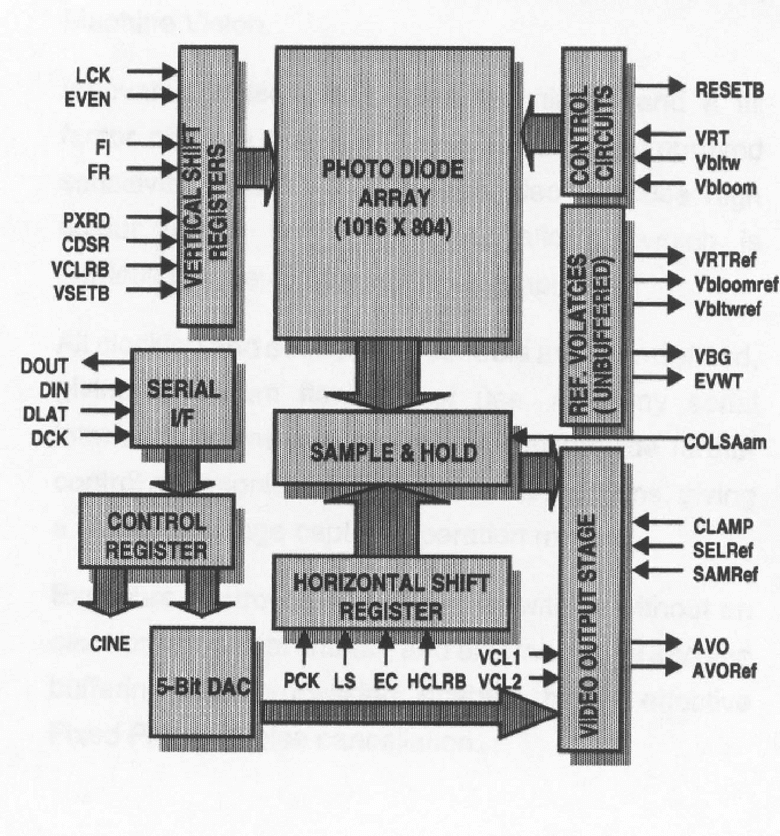
smaller vision systems. (Vision - High Resolution CMOS Sensors, VLSI Vision
Limited, UK and San Jose, May 1998)
One can say that higher intelligence was involved
in bird eyes since they have smaller pixels than our present cameras and
have vision systems that process in 3D. To do this nature's eyes use many
very small parallel connections, with some processing occurring between
the eye and the brain.
|
Figure 5-14 Diagram of Small
Camera Electronic Interface
for a Vision System.
|
This parallel processing allows a large number of
functions to take place simultaneously, as compared to typical serial (or
one operation following another) computer processing of figure. Programming
eye functions to work in parallel, or at the same time, shortens the overall
processing time, allowing three-dimensional recognition to occur at the
speed of observation. Limited serial processing is one reason why most
robotic systems have a difficult time matching the typical short reaction
times of insects.
In comparing typical computer communications
and nature's "computer communications," just imagine thousands upon thousands
of very small connections coming out of a video camera and going to a computer.
Even though man has come up with very small integrated circuits, where
connections on a computer chip can go down to as small as 0.15 micron,
the interconnections between the computer chips are dramatically larger
than the insect's tiny brain. Wires for attaching major computer subsystems
are much larger in diameter than many insect vision system cables. Now
imagine the size and cost of a cable made up of millions of wires going
from a camera to a computer to process visual data. If we take wires the
size of a human hair, or about 100 microns in diameter, then 1000 of these
would be approximately 100mm wide. Such a cable would be larger in diameter
than small cameras or computer plugs. This gives some perspective to the
image processing complexity of nature's eyes.
More importantly, we have to remember an eye
begins with a single cell and then grows by multiplying cells, while coordinating
millions of different cells for the vision process. Imagine the intelligence
to design, produce, integrate, and power all the different kinds of cells
that go into vision systems. Just the powering of modern flying robots
is still a very significant problem. Reproduction is even more of a problem
to explain without intelligent design.
4.
Flying robotics
Considerable new work is being done in this
area. There are a number of insect and bird size robots being considered.
Researchers are finding natural insect flight it is not a simple task to
duplicate. For example, the flight of insects and birds is so complex that
the smallest details provide significant engineering challenge. We have
already shown that vision is very complex, but the sense of smell in insects
like bees, or moths and wasps is so sensitive it could be used to sense
high explosives. So people building small robots with infrared detection
capabilities could learn a lot from beetles, vipers, and other small creatures.
Naturally, utilizing existing creatures would
be easier than creating new robotic bugs. In any case, there appears to
be considerable design effort required to build creatures that can fly
and see. Their power conversion system design is well beyond our present
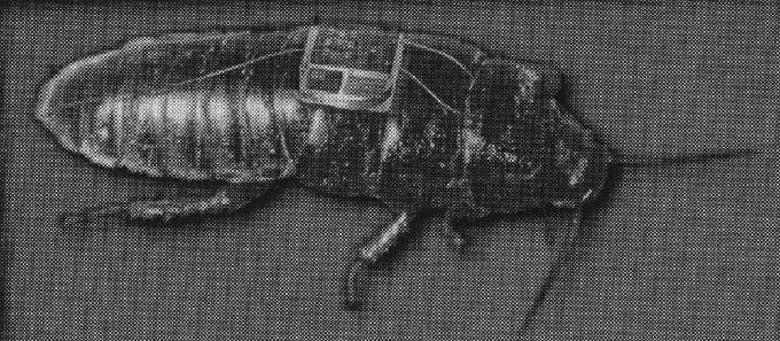
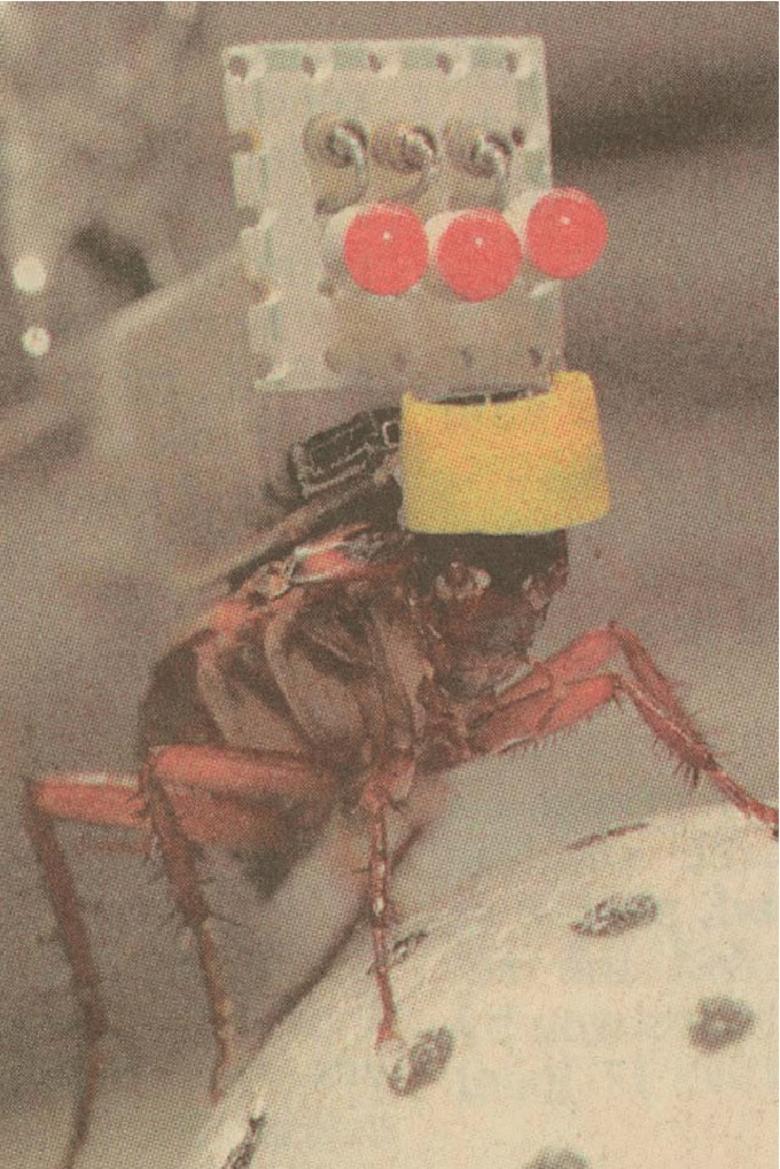
battery technology. An example of a robotic insect is shown in Figure 5-15
and biological insects adapted for a similar purpose are shown in Figure
5-16 and 5-17. |
Figure 5-17 Insect Robot
showing controls attached to
insect (Researched by
U. of Japan, reported by
Orange County Register, Friday,
June 10, 1997, News pg. 21)
|
Figure 5-15 Robotic Insects (NASA)
|
Figure 5-16 Insect Robot showing remote
controls attached to insect (SPIE
Micromachining & Microfabrication 1999
Symposium Technical Program)
|
5.
Microscope and endoscope applications
Microscopes have a long history of specialized
use for research. Now they are used more widely in businesses, schools,
and homes. Optical microscopes are able to magnify cells over 1000 times
to see them reproduce, to identify abnormal cells, and to examine the design
of molecular building blocks. See the optical diagram of a typical microscope
on figure 5-4.
Some new camera vision systems are designed
to have ultra violet (UV) imaging capability for high technology areas,
such as semiconductor fabrication. It takes very high-resolution short-wave
length UV image transfer capability and analysis of quality for the production
of today's integrated circuits for computers. Considerable intelligent
design and production effort also went into developing the process for
building very- high-resolution UV systems for semi-conductor production.
Even fifty years ago, people did not imagine
the feasibility of producing these advanced semi-conductor computers with
sub-micron features. This technology contributes to how we can produce
small artificial vision systems using human intelligence.
Some insects have UV capabilities, which human
eyes do not have. Insects are not able to see shadows or forms with nearly
as much resolution as humans, but they do an effective job of rapidly sensing
image motion as they travel. Much of their rapid image processing seems
to take place in the form of motion sensing over part of a scene. This
is quite different than processing each complete scene in full color. One
attempt to control a cockroach is shown in figure 5-17. Here the man-made
control mechanism is quite crude compared to the basic insect.
In comparing IR eyes of nature to typical
video IR night sight vision systems, one can see great value in the technology
of nature's small compact IR eyes to provide remote night-vision. This
typically allows one to visualize distant temperature sources or the temperature
distribution of hot objects. Improved compact IR vision systems may be
developed as a result of new viper eye research about IR vision capability.
During the last 200 years, straight optical
bore scopes were developed to see into body cavities. These developments
led to new flexible optical endoscopes containing flexible cables of glass
or plastic fiber optics to transmit images. Fiber optic endoscopes are
much more versatile than straight bore scopes that use optics to relay
an image within a small tube.
Flexible endoscopes are typically used to detect and
help correct abnormal conditions within the body or to identify conditions within
closed volumes not accessible to cameras or to direct viewing. A wide variety
of straight and flexible specialized endoscopic devices are now used to
enter all body cavities and some blood passages to view and correct conditions
inside the body. Minimal size holes are also cut in the body to gain entrance
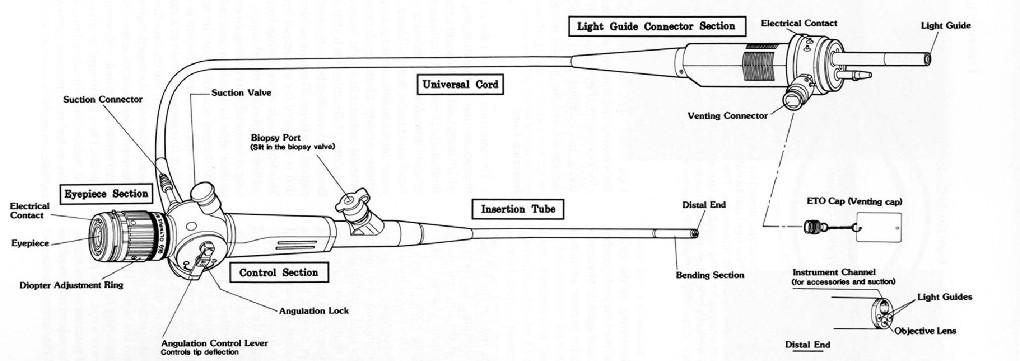
to organs a blood passage not accessed from body cavities. See the following
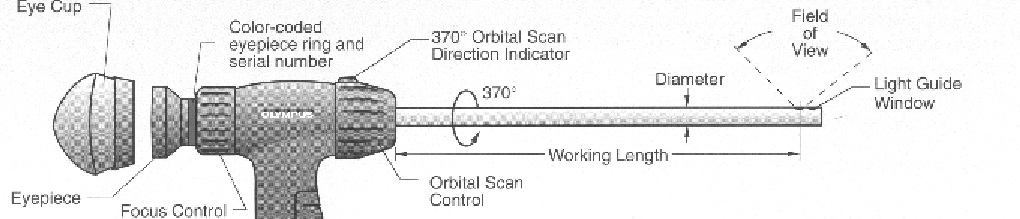
figures for illustrations of bore- scopes and endoscopes.
|
Figure 5-18 Diagram of Borescope
(Olympus Marketing Literature)
Figure 5-19 Endoscope Diagram (Pg. 4,
Fiberoptic Endoscopy and the difficult airways,
Andranick Ovassapian Typrocott Room, 1996)
|
Although there are large UV and IR optical devices
available, there are few small microscopes, borescopes,
or endoscopes with high-resolution UV or IR capabilities. Multi-spectral
technology would be desirable for microscopes and endoscopes used for cancer
research and detection and other applications. For example, detection of
many types of cancer could be made much easier if we had small intelligent
vision systems that could enter the body for direct analysis of tissue,
instead of taking tissue samples for evaluation using current instruments.
6. New technologies
to see the building blocks of cells
We have been able to see major components
of cells for some time, but have not been able to see details of very small
cell components. New technologies are starting to let us see more of the
fine details of the building blocks of nature, such as the construction
of chromosomes. Special man-made optical, confocal, electron-beam, and
atomic-force microscope systems can now be used to study DNA and other
key building blocks of life. The small DNA features are beyond optical
system diffraction limits, but electron beam and atomic force microscopes
allow scientists to form images of fine details that can approach enough
resolving power to sense the presence of individual atoms that make up
materials. These and other new techniques may be required to see genetic
DNA code information. Because of the way sample eyes have to be prepared
for analysis, it is very difficult to work with live cells using electron
beam microscope procedures that may require the process of coating surfaces
within a vacuum chamber.
Optical sensor resolution is beginning to
approach that required to see the interconnecting biological structure
that makes up the very intricate nerve cells of our retinas. New multi-color
fluorescence cell analysis is starting to provide detailed information
on the selective functioning of the large numbers of interconnections between
the nerve cells required for vision. Vision cells interconnections may
include 10,000's of connections per cell. These new discoveries are giving
us new insight into the complexity of our eyes' image processing system.
The size of these connections is small relative
to integrated circuits with conductors approximately 0.3 microns wide.
This compares to molecules as much smaller building blocks than the lines.
We need to remember that it takes 10,000 angstroms to equal one micron
or about 3,000 angstroms to equal a thin conductor width. As a comparison,
features of DNA code in cells are on the order of 10 angstroms
A new type of near-field optical microscope,
without conventional lenses, can be used to see detail as small as about
50 nanometers (.05 microns), but 1nm resolution may be required for comprehensive
DNA research within cells. Technologies are not yet
adequate for direct viewing of the complete DNA structure.
This could be similar to viewing a large segment of a CD ROM at one time.
Atomic force microscopes have to be positioned so close to samples, that
they risk cell damage. These instruments are somewhat cumbersome, difficult
to use, and have limited fields of view, compared to simple optical or
electronic microscopes. Sensitive high-resolution microscopes and related
systems require stabilization to function, as compared to typical lower
resolution microscopes, working without stabilization. For illustration
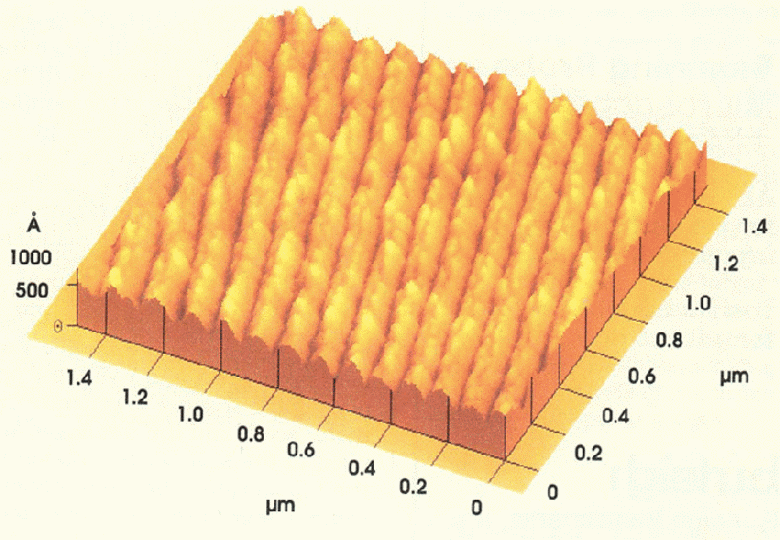
of their small field of view a typical image is shown, in Figures 5-20
(Photonics Design and Applications Handbook, 1996) and 5-21 (Pg. 19 Laser
Focus World, Jan. 2000. This is one reason why research in this area
will take so much time, and does not give wide-field visibility needed
for detailed cell studies.
|
Figure 5-20 Image From
Near-field or Atomic
Force Microscope of
an optical coating
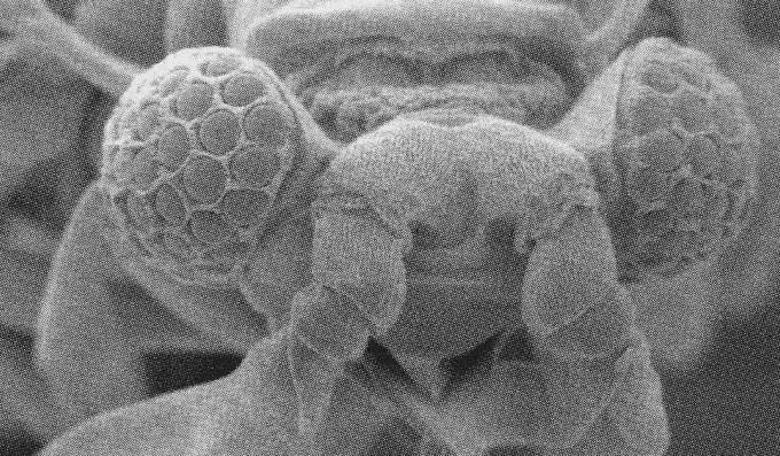
Figure 5-21 Image of a Wasp
Parasite from an Electron-
beam Microscope image --
Image of a parasite that
lives inside a wasp.
|
Rapid parallel
processing by groups of cells, with thousands of connections per cell,
is one of the most amazing features of the vision process. Since it is
so difficult to view these parallel inter- connections, it is very difficult
to design a means to reproduce the thousands of interconnections between
cells. Just imagine the processing taking place in the insect parasite
shown on figure 5-21 and the interconnections
between cells. The programming and connections necessary for time-efficient
parallel processing by the brain has to be designed and in place to allow
vision.
Considerable design effort was necessary to
form stable images for moving man-made vision systems, in order to provide
feedback to control where the eye looks. This is no less true of eye stability
design in nature. We are still learning how to build better, stable, moving
optical systems leading to better vision system platforms. As we learn
more about nature's eyes, it can help designers provide more stable structural
mountings for optical systems.
Many different scanning eyes are used
in various small animals where the space and potential resolution
is limited. This requires some special processing of the visual
information, especially when used with additional Eyes that do not
scan. The following table illustrates several applications of
scanning eyes. (Reference: table 9.2, p. 197, Animal Eyes,
Michael F. Land, Dan-Eric Nilsson, Oxford Animal Biology series,
Oxford University Press, 2002- Please see their book for more details )
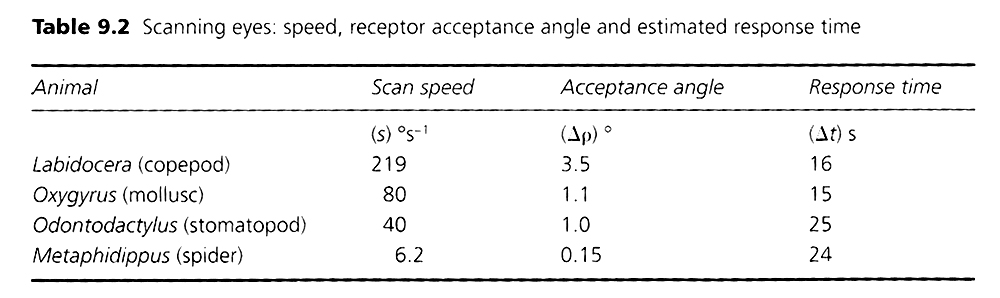
Figure 5.21a Table Showing Examples Of Scanning Eyes
|
|
|