lined link to go to subject)
 - Contents
Chapter 1. Vision
System Design
Chapter 2. Biological Eye Designs
Chapter 3.
Eye
Design
Illustrations
A.
Plant
light sensing
1.
Grass, simple vines,
and stems
2.
Flowers
B.
Lower
animal eyes
1.
Flatworms
2.
Clams and Scallops
3.
Nautilus
4.
Shrimp
5.
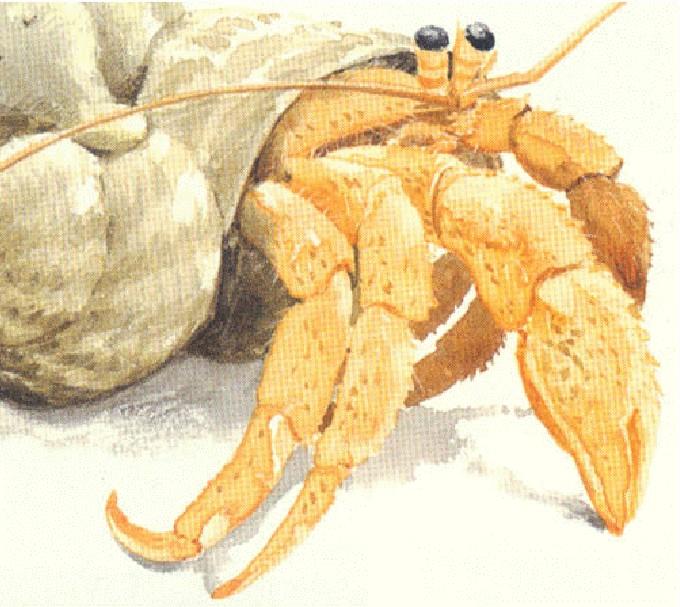
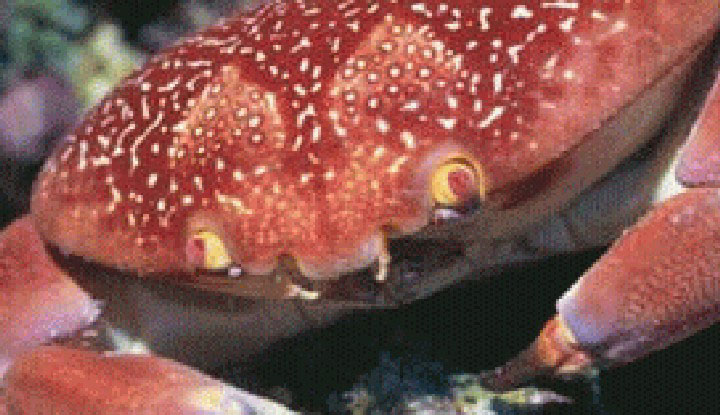
Crab
6.
Octopus and
giant squid
7.
Spiders
8.
Scorpions
8.
Brittle Star
C.
Insect
eyes
1.
Bees
2. Dragonflies
3. Butterflies
4.
Flies
5.
Ants
6.
Moths
7.
Beetles
8.
Wasp
D. Fish
eyes
1.
Shark
2.
Flounder
3.
Four-eyed fish
E.
Amphibian
eyes
1. Frog
2.
Salamander
F.
Reptile
eyes
1. Boa
constrictor
2.
Rattle
snake
3.
Lizard
4.
Turtle
5.
Crocodile
and
alligators
G. Bird
eyes
1.
Eagles
2.
Hummingbirds
3. Owls
4.
Ostrich
5.
Cormorants
H.
Mammal
eyes
1.
Whales
2.
Elephants
3. Lions,
tigers, and
other cats
4.
Monkeys
5. Rats
and mice
6. Bats
7.
Tarsier
I.
Human
eyes
1. Iris
2. Lens
3.
Retina
Chapter
4. Eye
Reproduction
Chapter
5. Optical
Systems
Design
Chapter
6. The Eye Designer
Related
Links
Appendix
A - Slide Show & Conference Speech by Curt Deckert
Appendix
B - Conference Speech by Curt Deckert
Appendix
C - Comments From Our Readers
Appendix
D - Panicked Evolutionists: The Stephen Meyer Controversy
Chapter 3
Section B
-
Prev Page
Go
to Chapter Links
-  Next Page
-
Next Page
- 
(Click on PICTURE IN TEXT to bring up LARGE PICTURE)
3. EYE DESIGN ILLUSTRATIONS
B.
Lower animal eyes
Lower animal eye designs are extremely creative and diverse, compared
to complex animal eyes. They include variations of all of the major
optical design categories that we can sample from categories already
discussed in section II. The primary function of the least-complicated
lower-animal eyes is to provide indications of the environmental light
intensity for sensing danger or for food gathering. For most simple
eyes, this is their main function. Some simple eyes do not even have a
pinhole optical element to form a simple image.
3. Nautilus
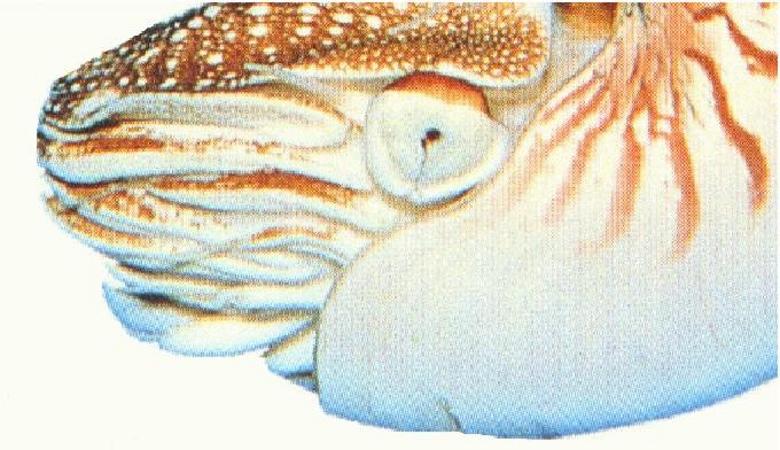
The nautilus (Fig 3.6) is a small mollusk with squid-like tentacles. It is one of the better examples of animals with medium-resolution pinhole optics, which require more light than camera-type eyes, in order to see quality images.
Since the nautilus is able to see polarized light to determine their course of direction, they navigate with respect to sunlight. Their resolution compares to the eyes of some larger animals and man-made vision systems. Since the nautilus has complex arms to control, it requires more visual information than less complex animals such as flatworms. (P. 281, Readers Digest, Exploring the Secrets of Nature, 1994)
4. Shrimp
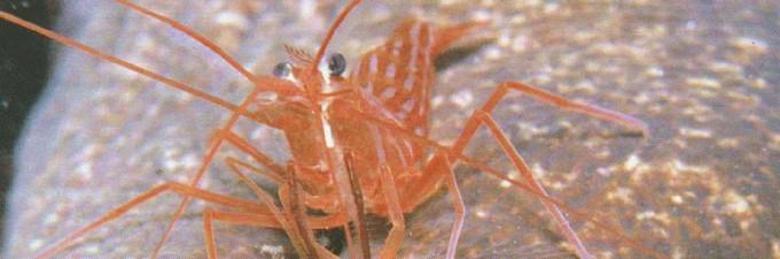
Some crustaceans, such as shrimp, have light-sensitive sensors on their bodies and tails in addition to their primary eyes. Shrimp eyes appear to be more complex than those of many small animals such as the nautilus. They use multiple eye facets to sense specific areas of a scene. In addition, they use a reflecting superposition optical approach, which requires a considerable amount of image processing in their small brain. One might ask why a reflecting optical system was used for shrimp eye design.
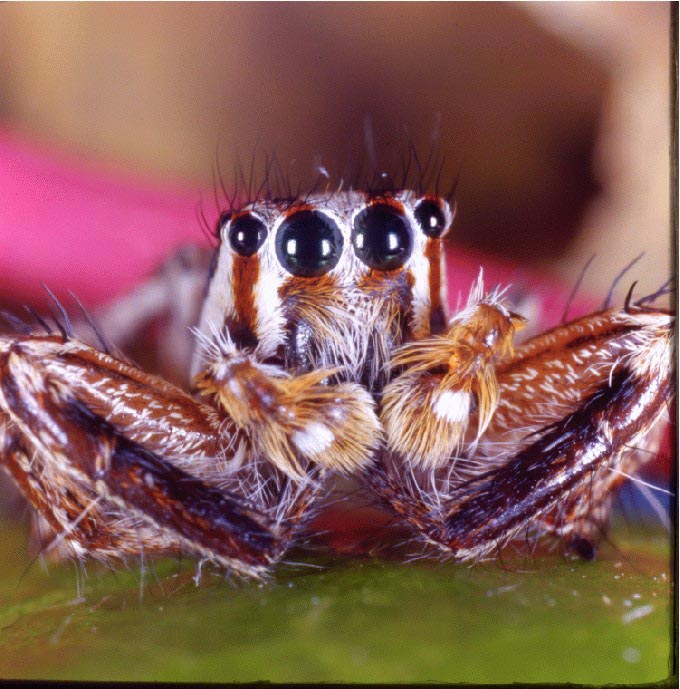
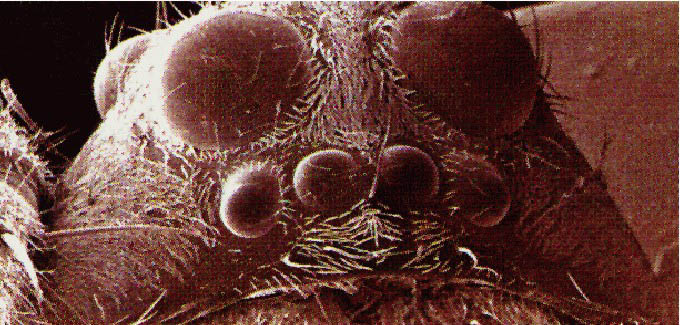
| 6. Octopus and giant squids The octopus has a fairly advanced camera type eye, with an active rectangular iris which contracts to a narrow slit. It can focus its eye lens for near and far vision, but does not have well-defined vision, like humans. This intelligent animal needs adjustable focus eyesight to provide a basis of control for all its arms, as well as look for food and watch for predators. The giant squid eye is amazingly well developed, with fairly good vision. Since the giant squid is about 180 feet long, it has the largest biological eyes in the world. Its eyes are about 100 times as large as human eyes. Like many eyes, its light-sensitive cells point toward the light, rather than away from it as ours do. Its image processing is well beyond that of many man-made robots. This eye has both a wide field of view and smaller areas of increased resolution. It sees blue-green light well, because its eye pigment color passes blue-green light better than other colors. The eye can also detect polarized light to determine the direction of sunlight. These would be interesting eyes to study, but they are difficult to obtain. Now we get into some land-based versions of small simple eyes. The Octopus Eye shown in Figure 3.9c has a very interesting slit pupil. It also indicates an interesting design. (Reference: plate 1c, p. 117, Animal Eyes, Michael F. Land, Dan-Eric Nilsson, Oxford Animal Biology series, Oxford University Press, 2002- Please see their book for more details ) 7. Spiders Spiders have simple eyes, compared to the compound eyes of many insects. Spiders with only six eyes do not have primary eyes. These include daddy longlegs and many weaving spiders. In spiders that have eight eyes, the number of eyes does not necessarily classify complexity or define a more advanced vision system. For example, the wolf spider has multiple eyes that have various roles. Some provide forward vision while others may scan to provide for peripheral vision. The eye signals going to the brain are combined to provide peripheral vision, distance estimating,and image formation. Spiders do not have complex lens focusing, but they have multiple eyes for limited color vision at different distances. Some spiders also detect polarized light. Eyes of some spiders have a narrow field in one direction, but they may also be able to scan in that direction by moving the eye. Their visual pigments transmit in the ultraviolet and green-spectral regions. Spider image processing is astounding. Their brain processes several optical fields of different angular dimensions at the same time. It is really amazing that their small brains carry out complex image processing approaching that of complex man-made multi-sensor weapon or robotic systems. The black widow spider could be a true stealth weapon, if it could be controlled by man at some reasonable cost. It has multiple eyes for fixed wide-field vision to see enemies, find food, and to do close work in building webs. Most spiders do not have good vision at longer distances. Their eyes are like camera eyes, but they do not focus as well as modern cameras. (Figure 3.10a, p.24 upper left, Readers Digest, Exploring the Secrets of Nature, 1994) (Figure 3.10b courtesy of www.pbrc.hawaii.edu/bemf (c)MicroAngela Black & white images colored for visual effect.) A few spiders see in very low levels of light, which indicates unique vision capabilities. One example is the net casting spider (fig3-10c), which can see about 2,000 times better than jumping spider. To achieve this capability, it has eight eyes. At least one pair of these eyes has an f/stop (like control of the effective aperture of camera optics) of approximately f/0.58. This is equivalent to a very fast lens useful for detecting low levels of light. It is very difficult to design. This is actually approaching an optical limit for a camera type of eye lens design. (P. 170 upper, Readers Digest, Exploring the Secrets of Nature, 1994) |
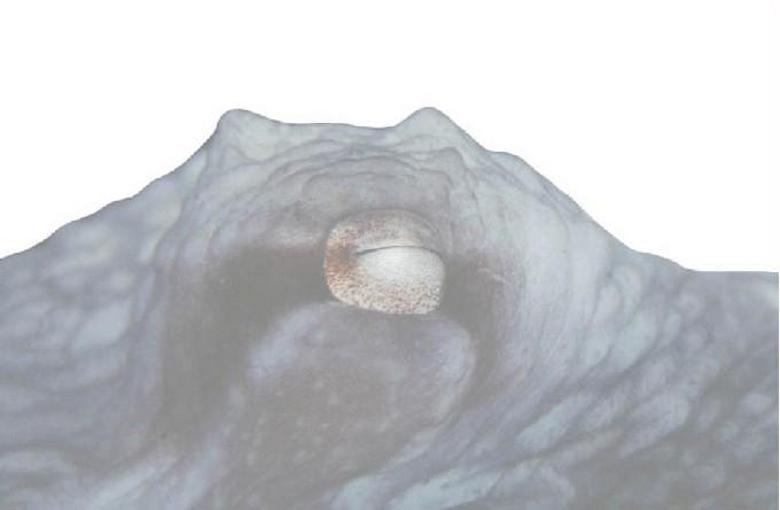
Octopus Eye. by Bruce Chambers 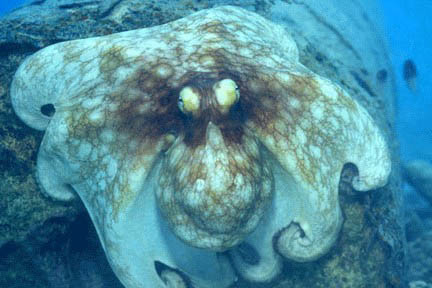
M. Westermeier Photograph 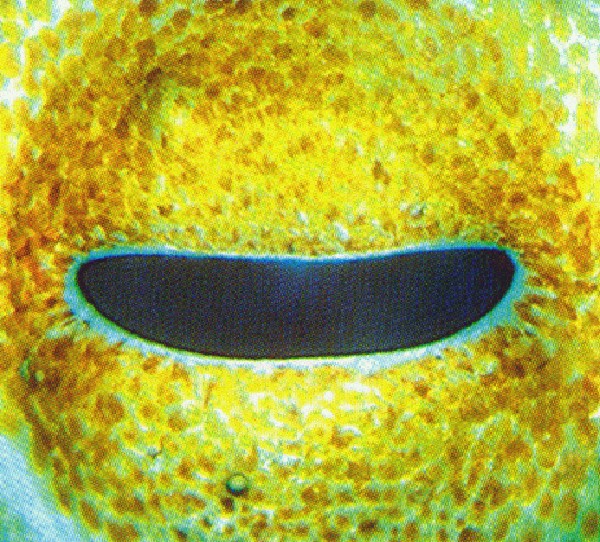
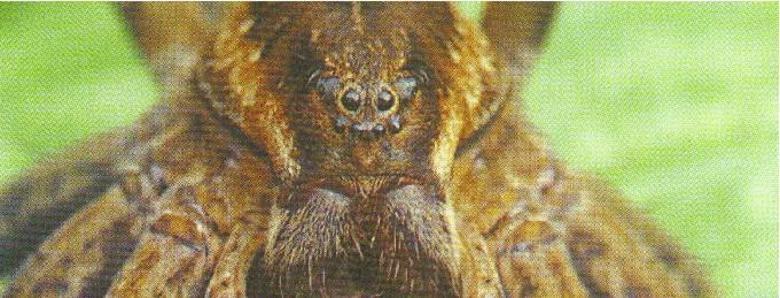
Spider Eyes. 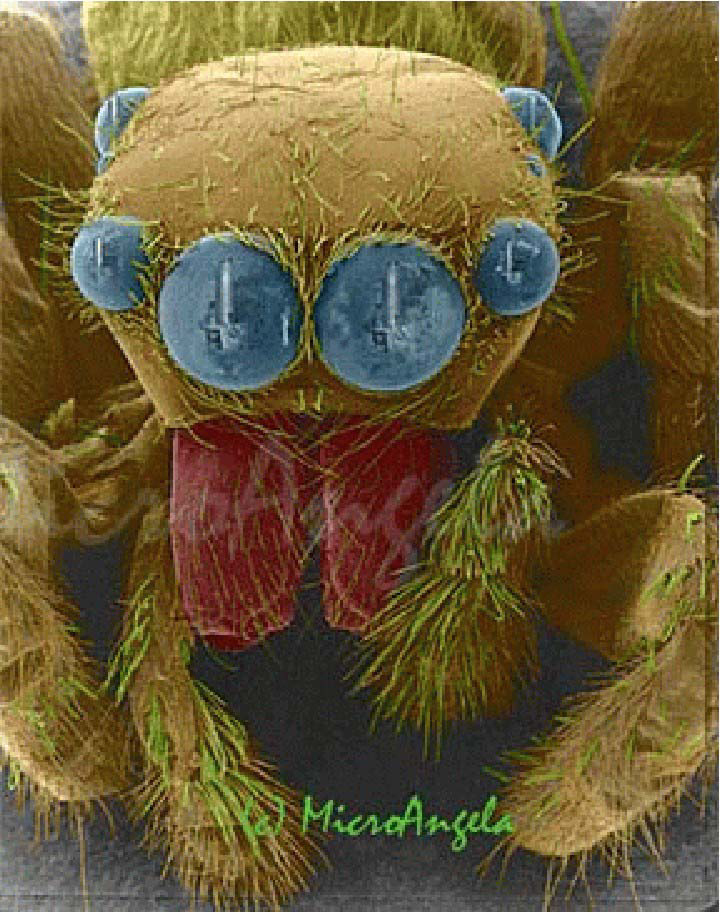
Spider Eyes. 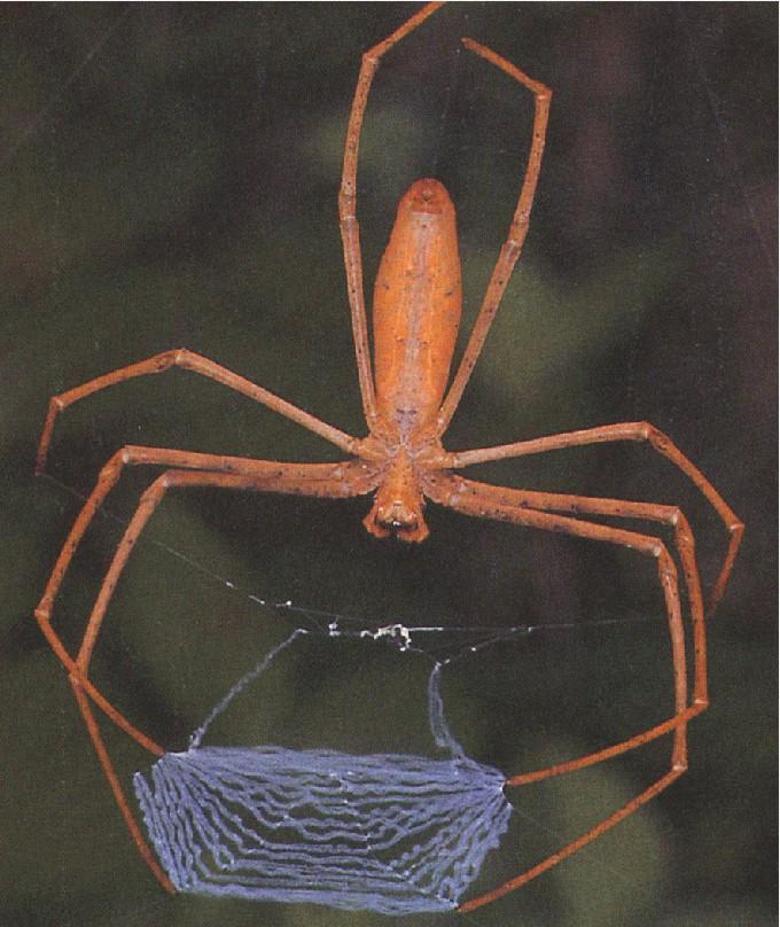
|
|
In general, spider eyes have
very creative optical designs. They appear to have been designed for
specific purposes. Although spiders are not insects, some of their
small, less-complex eyes are somewhat similar to some insect eyes
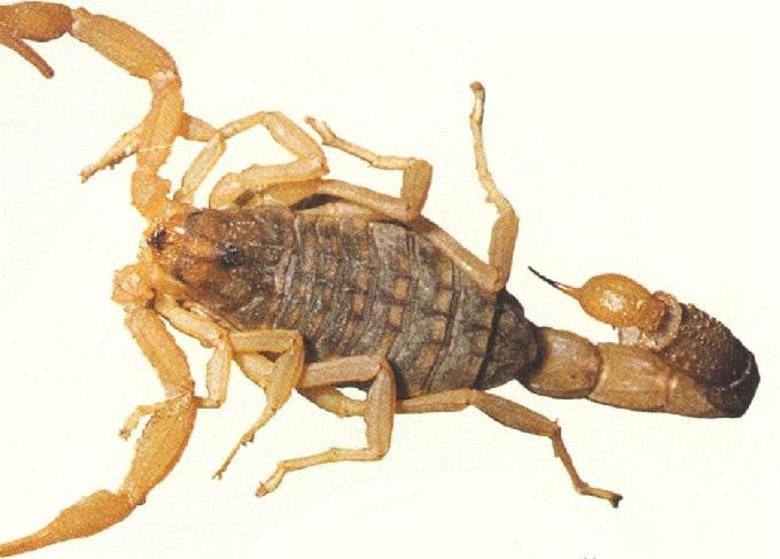
facets. Figure 3. 10d. is a spider photo by Geoff Woodard, who has a number of excellent insect and other related photos on the web. This photo illustrates a spider with four eyes to note the diversity of spider eye arrangements. In general, spider eyes have very creative optical designs. They appear to have been designed for specific purposes. Although spiders are not insects, some of their small, less-complex eyes are somewhat similar to some insect eyes facets. Figure 3.10e Spider Eyes. Note the variation in Spider eye configurations. This photograph was done with a scanning electron beam microscope for an ugly bug contest. (reference:Biophotonics International, June 2002, page 86) 8. Scorpions Scorpion eye design is really different in that they may have zero to twelve eyes. The average is about eight for most of the common types. Some eyes are arranged in three widely-spaced clusters. Because they have potent stingers it is expected that their eyes have not been studied up close in nature as much as other animals. They work at night. When you shine UV light on them they appear to be fluorescent. They do not see as well as many animals, but they sense shock waves with two of their feet. Scorpions have four pair of walking legs, one pair of pincers, a pair of appendages to act as jaws, and another pair having vibration-sensing ability. They can orient their stinger or eyes toward the source of the vibration or shock wave. (P. 166 lower, Readers Digest, Exploring the Secrets of Nature, 1994) 9. Brittle Star
|
day and night |
|
Distributed processing
indicates intelligence to do the optical processing to control all of
its members for fast motion and provide for changing of color
form day to night. Its nodule-like eyes form a micro-lens array that
also act as part of the surface structure. This somewhat diffuse vision
system has to control complex movements and provide signals for overall
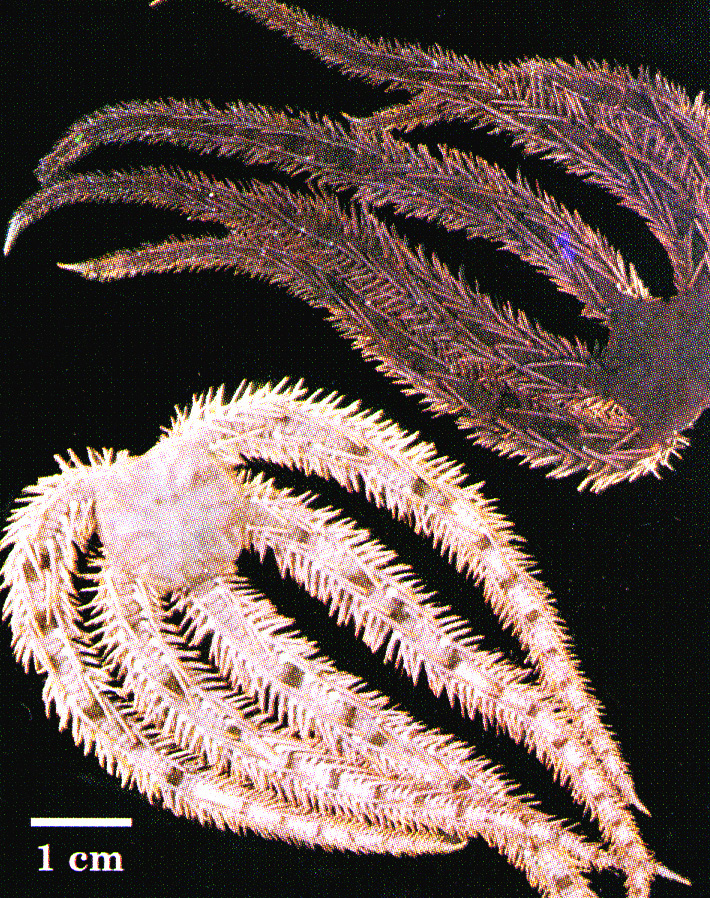
color changing. There is current research to study the optical design and construction of the large amount of eyes that cover much of its body. Because of possible current applications in the communication industry requiring their fine focusing ability, these lenses are good evidence of advanced lens array design. It wasn't long ago that we did not appreciate this optical design that illustrates a strong example of intelligent design that has survived many years. The following illustrations give some indication of the overall design. (Figure 3.12b - d from p. 20, R Fitzgerald, These Stars Have Eyes, Physics Today, Oct 2001) effect.) |
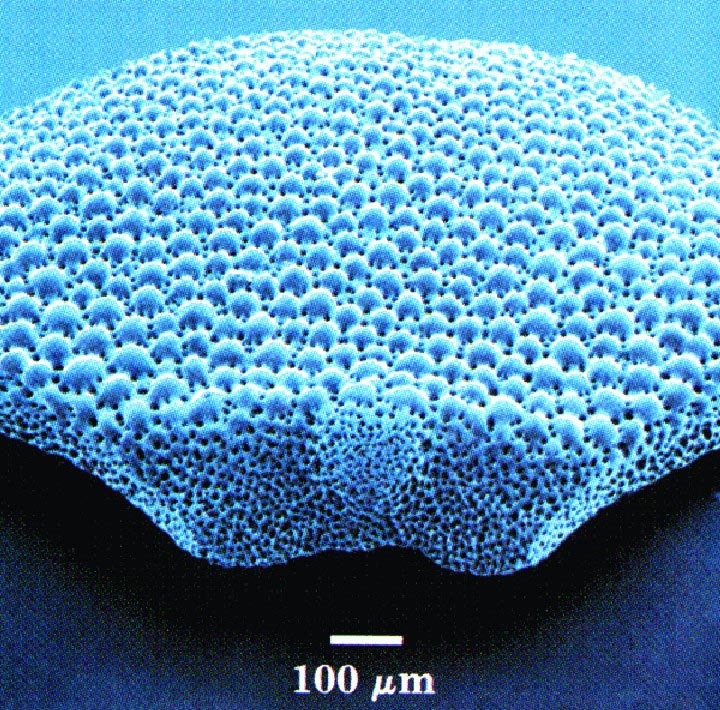
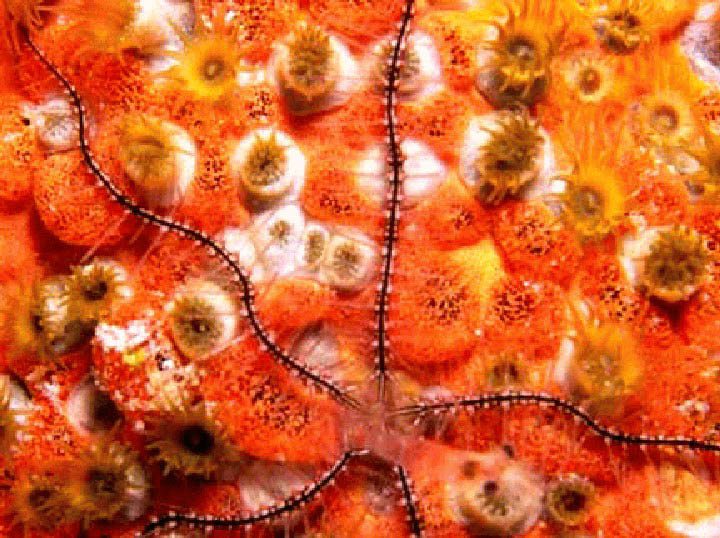
M. Westermeier Photograph |
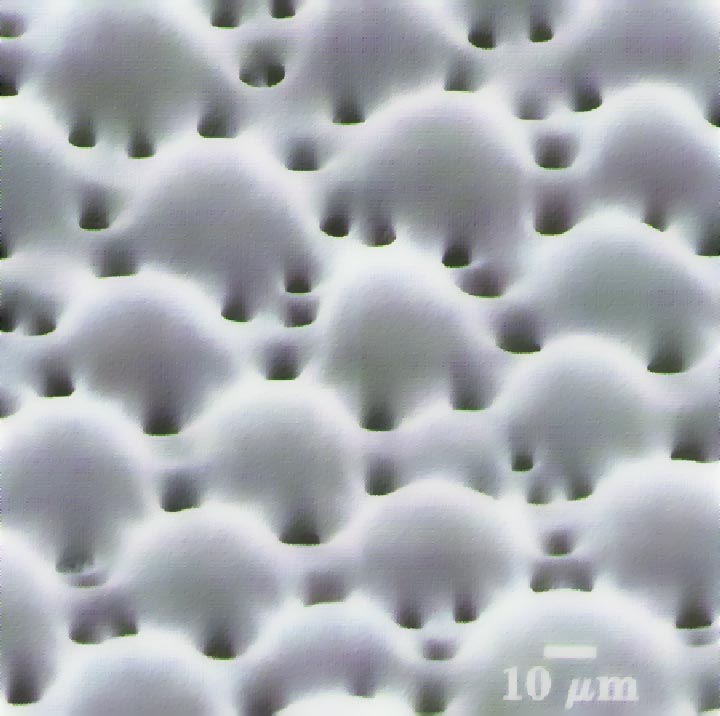
Fine Detail 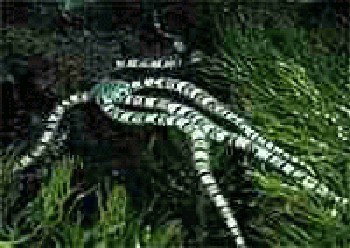
by Schayeri |
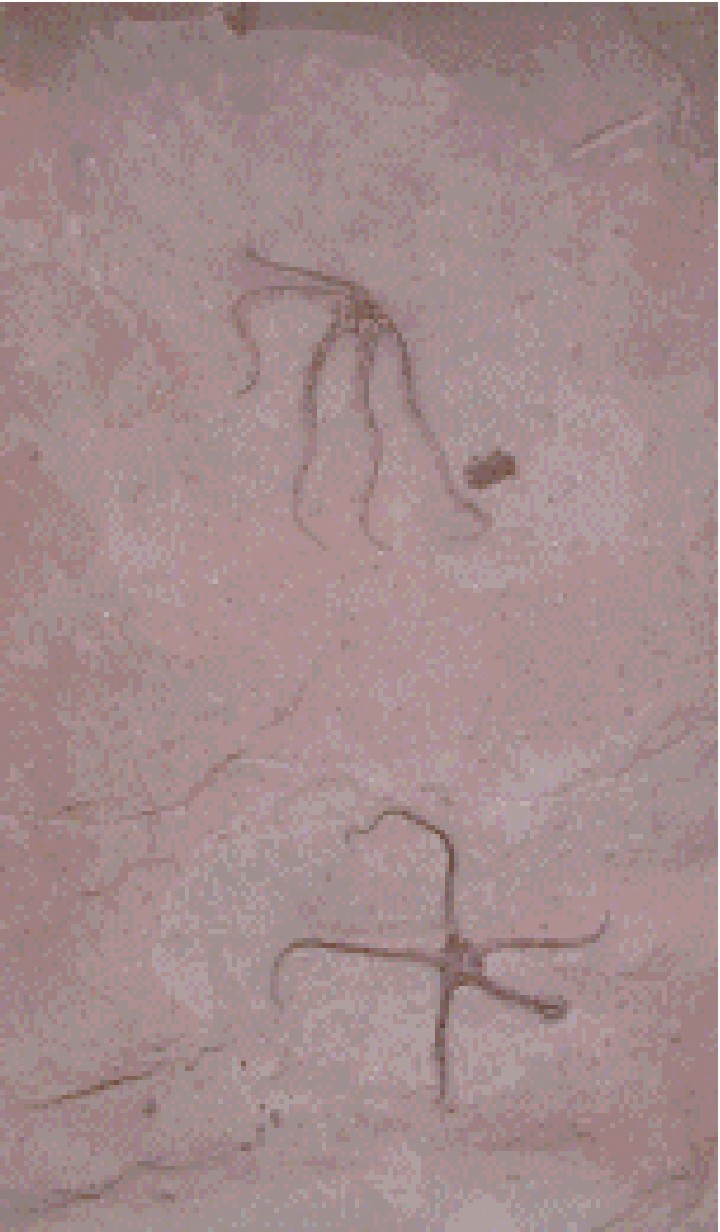
Fossil |
Click the following link for a good example of why scientists use the word design when discussing the profound complexity of eyes, even in a very early organism like the trilobite, extinct for more than 200,000 years. The advantage of good eye design in "The Trilobite Eye" by S. M. Gon III
If one were looking at the brittle star from the point of view of evolution one might suspect that you would see an eye something like that of a squid or shellfish eye. From what we have seen this far, what would drive evolution in this direction?
How would you design a replication system for this multiple eye vision system?
Although there are many interesting eyes, the following area of design application includes many variations of different eye designs within a variety of insects. These illustrate some of the significant variations in insect eye designs.
