lined link to go to subject)
 -
Contents
-
Contents
Chapter 1. Vision
System Design
Chapter 2. Biological Eye Designs
Chapter 3. Eye
Design Illustrations
A. Plant light sensing
1. Grass, simple vines,
and stems
2. Flowers
B. Lower animal eyes
1. Flatworms
2. Clams and Scallops
3. Nautilus
4. Shrimp
5. Crab
6. Octopus and
giant squid
7. Spiders
8. Scorpions
8. Brittle Star
C. Insect eyes
1. Bees
2. Dragonflies
3. Butterflies
4. Flies
5. Ants
6. Moths
7. Beetles
8. Wasp
D. Fish eyes
1. Shark
2. Flounder
3. Four-eyed fish
E. Amphibian eyes
1. Frog
2. Salamander
F. Reptile eyes
1. Boa constrictor
2. Rattle snake
3. Lizard
4. Turtle
5. Crocodile and
alligators
G. Bird eyes
1. Eagles
2. Hummingbirds
3. Owls
4. Ostrich
5. Cormorants
H. Mammal eyes
1. Whales
2. Elephants
3. Lions, tigers, and
other cats
4. Monkeys
5. Rats and mice
6. Bats
7. Tarsier
I. Human eyes
1. Iris
2. Lens
3. Retina
Chapter 4. Eye
Reproduction
Chapter 5. Optical
Systems Design
Chapter 6. The Eye Designer
Related Links
Related Links
Appendix A - Slide Show & Conference Speech by Curt Deckert
Appendix B - Conference Speech by Curt Deckert
Appendix C - Comments From Our Readers
Appendix D - Panicked Evolutionists: The Stephen Meyer Controversy
Chapter 3
Section A
-
Prev Page
Go
to Chapter
Links
-  Next Page
-
Next Page
- 
(Click on PICTURE IN TEXT to bring up LARGE PICTURE)
3. EYE DESIGN ILLUSTRATIONS
A. Plant light sensing
Plants, like animals, are able
to sense light.
Plant-design genetic codes enable the production of photo-sensors to
slowly
sense light, which they usually grow toward. Plant light sensors are
relatively
crude compared to the eyes of mobile creatures. They show reaction to
light
by the opening or closing of a flower or by some other similar action.
Most plants respond to environmental changes. One method is by sensing
light and then growing additional roots and other support structure
that
may contain more sensitive cells to receive more light. Thus plants
show
a degree of intelligence or the ability for adaptive corrective
action.
| Though plants do not contain identifiable eyes like animals, they do include fungus-like cells (Fungi are not plants. Plants, animals, bacteria, and fungi are different kingdoms of life) which contain light-sensitive pigments. These cells control growth of fungus spores to grow in the direction of maximum light. An example of a common fungus is shown on Figure 3.1. (Pg. 16 Bugs, Bloodsuckers, Bacteria and More by Peter Brookesmith, Barnes & Noble, 1999) | 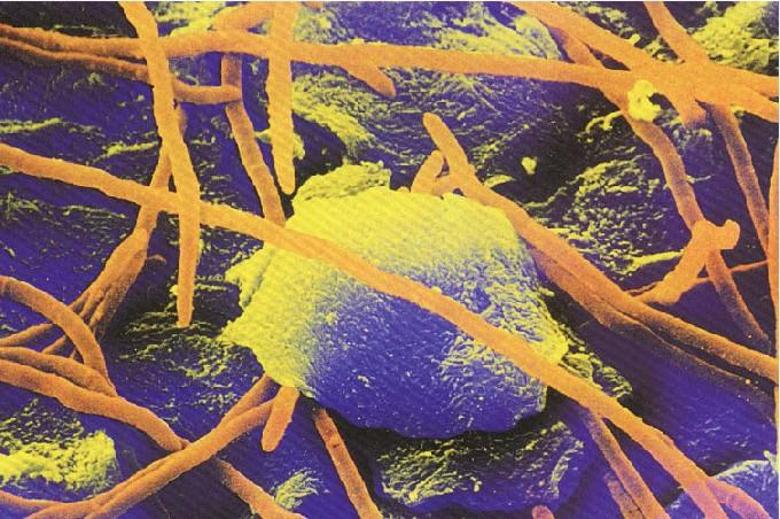
filaments of fungus on skin |
Click for Chapter
--
Contents
Eye Home Page
[Chap-1a]
- [1bc]
[Chap-2abc]
- [2def]
- [2ghi]
[Chap-3a]
- [3b]
- [3c]
- [3d]
- [3e]
- [3f]
- [3g]
- [3h]
- [3i]
[Chap-4a]
- [4b]
- [4cd]
[Chap-5ab]
- [5cd]
[Chap-6a]
- [6b]
- [6c]
Related
Links
Appendix
A - Slide Show & Conference Speech by Curt Deckert
Appendix
B - Conference Speech by Curt Deckert
Appendix
C - Comments From Our Readers
Appendix
D - Panicked Evolutionists: The Stephen Meyer Controversy
Table of
All Figures
