(Click on underlined
link
to go to subject)
 - Contents
Chapter
1.
Vision
System Design
Chapter
2. Biological Eye
Designs
Chapter
3. Eye
Design
Illustrations
Chapter
4. Eye
Reproduction
Chapter
5. Optical
Systems
Design
A.
Introduction
B.
Manufactured
optics
1.
Astronomy
and
surveillance
2.
Stable
platform for
optical systems
3.
Robotic
camera
applications
4.
Flying
robotics
5.
Microscope
and
endoscopic applications
6. New
technologies to see building blocks of cells
C.
Present
vision system technology approaches toward artificial eye
development
D. Integration
of mans technology with
biological eyes
Chapter
6. The Eye Designer
Related
Links
Appendix
A - Slide Show & Conference Speech by Curt Deckert
Appendix
B - Conference Speech by Curt Deckert
Appendix
C - Comments From Our Readers
Appendix
D - Panicked Evolutionists: The Stephen Meyer Controversy
|
EYE DESIGN BOOK
Chapter
5
Sections C and D
- Prev Page
Go
to Chapter Links
-  Next Page
-
Next Page
- 
(Click on PICTURE
IN TEXT to bring up LARGE
PICTURE)
5. OPTICAL SYSTEM
DESIGNS LEADING
TO
ARTIFICIAL EYES
C.
Present Vision System Technology
Approaches Toward
Artificial Eye
Development
New optical system designs are
usually developed for very specialized tasks. For example, machine
vision systems use complex lighting and optical systems to form images
on camera sensor for a particular purpose.
|
Only a few wires are used for
serial computer processing of electronic camera images. Some new camera
sensing systems have limited processing intelligence on detector chips
in order to approach some of the advantages of retina parallel
processing. There may be millions of interconnections on a computer
chip, but very few output signal conductors. Human sight, as we know
it, would be much more difficult without some pre-processing of the
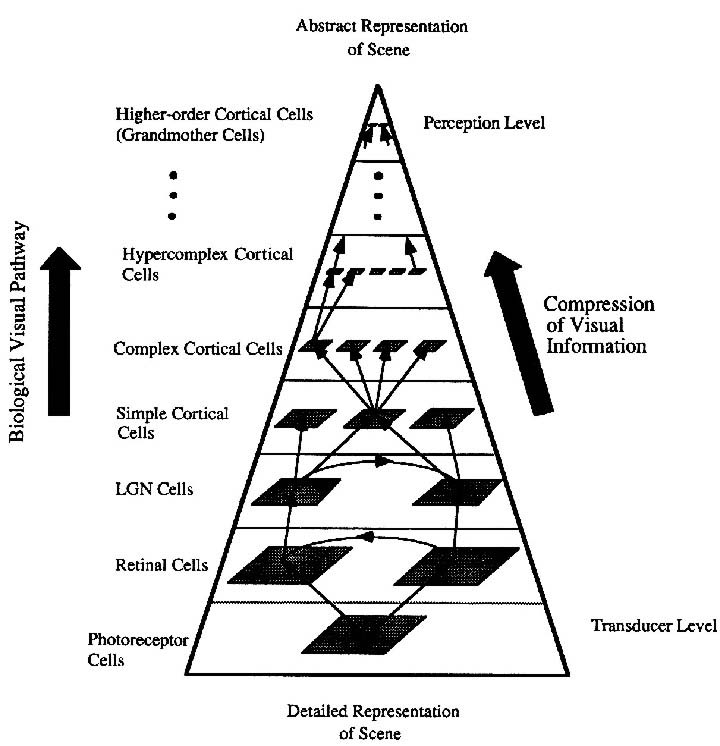
parallel image data coming from 125 million rod sensors. The diagram in
figure V-i shows the necessary functions of visual development required
beyond the optical function. The vision processor design is even more
complex than the basic eye optics. (Pg. 4, Neuro-Vision Systems, Ed. by
Madan M. Gupta, George K. Knopf, IEEE Press, 1994) |
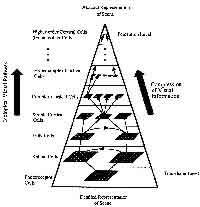 Figure
5-22. Visual Function
Figure
5-22. Visual Function
for Vision Systems
beyond the
optical function.
Like fig. 4-03
|
Some new imaging innovations
are starting to function similar to nature's eyes. The first example is
a wide-angle motion sensor device developed in Australia. It is
patterned after a multifaceted or compound insect eye. There are
considerable applications for this type of wide-angle sensor. It uses a
small microchip optical sensor that sees and thinks, to make simple
decisions based on its vision. The sensor actually sees a shadow of an
object, much as some insects do with their limited brain processing
power. These new sensors are examples of parallel processing, with
separate control of each of the many sensors. Hopefully, more of
nature's eye designs can also be applied to motion detection for
applications such as detecting blind spots for vehicle on roads and for
robotic forklifts in a warehouse.
|
These designs can be applied
to function at UV, visible and IR wavelengths, by designing with
materials that will transmit the required
wavelengths.
Considerable effort has been focused on developing visual aids for
people with little or no natural vision. Some progress is being made in
artificial eye development to aid vision where it is flawed or missing.
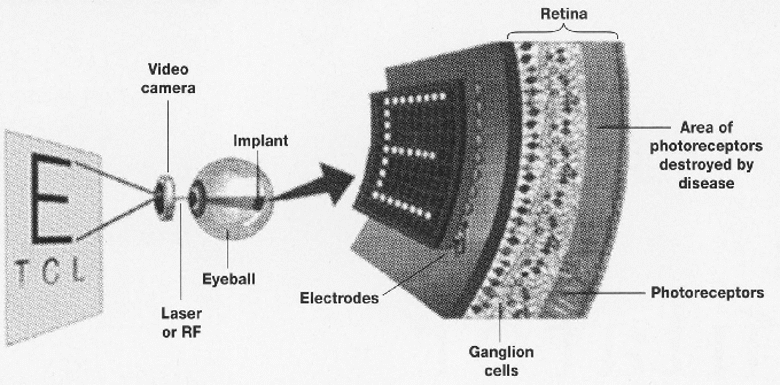
Figure 5-23 shows one approach to an artificial retina. (Pg. 32, Vision
System Design, June
1999) |
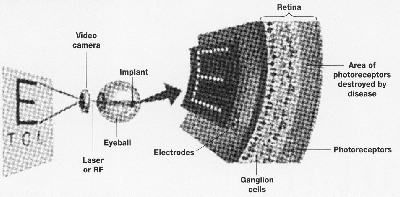 Figure
5-23 Concept for
Figure
5-23 Concept for
artificial retina
inserted
as part of
retina
|
Artificial retinas are being
pursued for a variety of purposes, such as partially replacing key
parts of human vision. Some of these are beyond an active display
providing an image directly on the retina. They will actually
try to transmit some type of image data directly to extensions of optic
nerve cells. The design of man-made eyes is made extremely difficult
because of the wide range of lighting conditions under which human eyes
typically function. For example, it is often very difficult for
man-made vision systems to see clear high-resolution color images in
very low light conditions. The following figure notes another future
concept for an artificial retina. {Pg. 20, IEEE Spectrum, May
1996)
Systems presently under
development, to be marketed several years from now, are expected to be
able to aid those who have no vision or very poor vision. For example,
new work on artificial eyes at the University of Michigan, North
Carolina State University, John Hopkins University, and the University
of Texas at Austin is being done using microchip and other related
technology. Some claim spectral capabilities beyond those of the human
eye, but their usability remains to be seen. Their eye consists of a
series of micro-mechanical lenses less than a millimeter in diameter. |
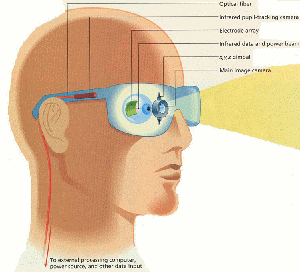 Figure
5-24 Toward an
Figure
5-24 Toward an
artificial eye
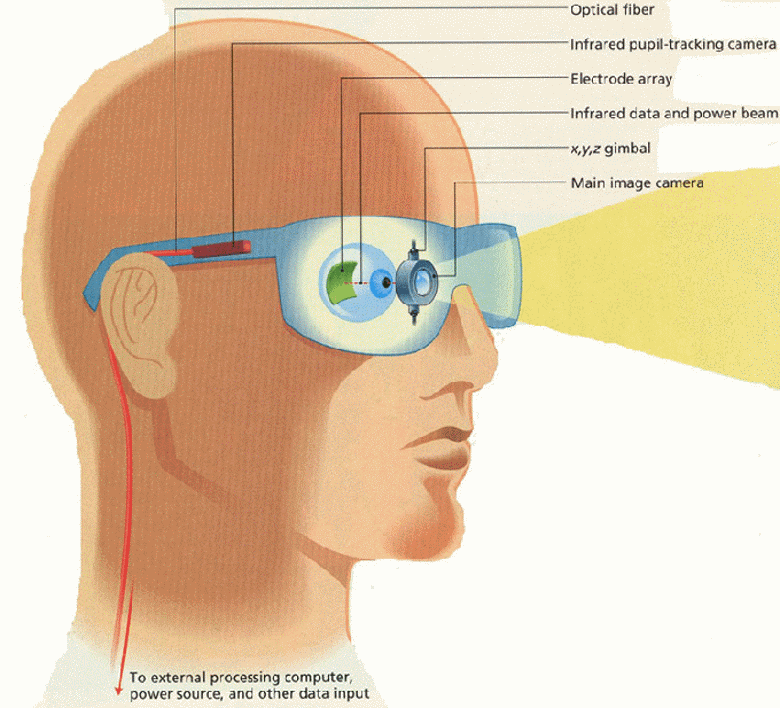
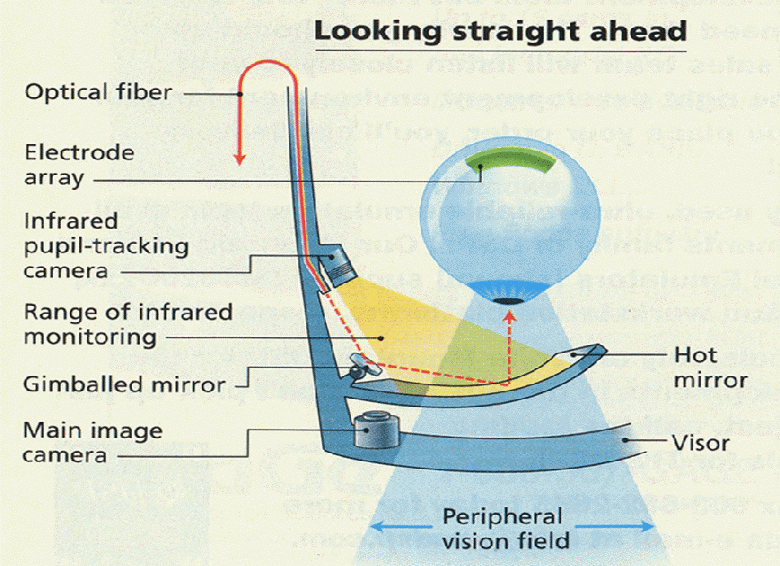
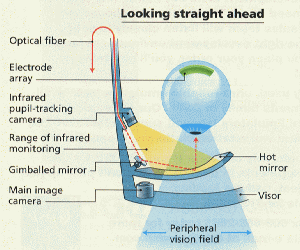 Figure
5-25 An Implanted
Figure
5-25 An Implanted
Array in the retina
and
supporting Camera
System
|
This device makes use
of tunable lasers on the chip for transmission of information to a
suitable interface in the existing eyes. By designing components with
appropriate materials, one could then see in UV, visible, or IR
wavelengths. The following approach shows one possible way to aid the
retina with an implanted array. (Pg. 20, IEEE Spectrum, May 1996)
This approach can use
a series of variablebr focus lenses in one module, while another module
is used to process information coming over optical fibers. Here the
speed of information transfer could be great, but the technology
required for systems with large numbers of parallel channels needs to
be developed. Many researchers are just beginning to appreciate the
human eye.
A number of smart cameras, or
camera sensors with computing functions on the same chip, are being
built and sold for machine vision applications. These smart cameras are
beginning to cut in on other markets requiring more expensive computer
interfaces and software. Additionally, the task of
interfacing power and information to eyes is a significant task. One
way to accomplish that is shown in Figure 5-25. Manufacturers are
starting to integrate computer and image sensor chips. So far, these
smart cameras are limited to fairly simple inspection tasks where the
object orientations and light are quite constant. The variety of motion
that can be accommodated by this vision system may be quite dependent
on the lighting.
As we further study nature's
eye systems, we may be able to take advantage of eye designs that can
be developed for new products using new manufacturing technology.
Technology extracted from nature's eyes is opening new doors. Remote
analysis of medical problems using recognition systems may be one of
the best application opportunities for new vision technology. For
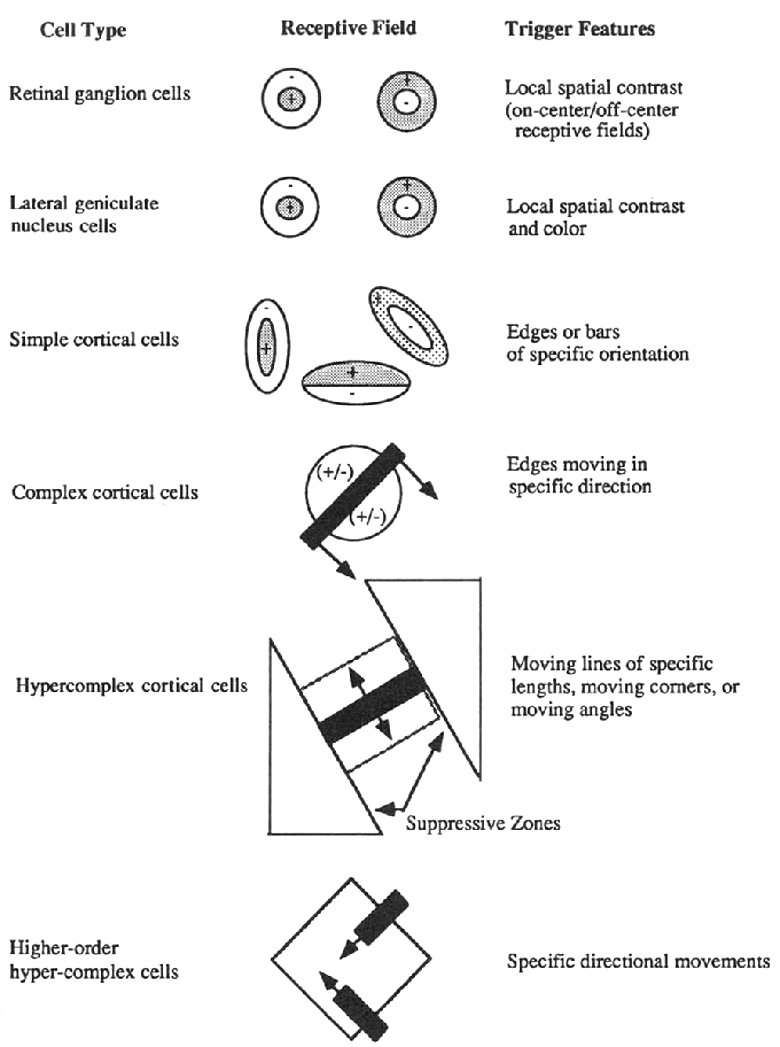
example we may pattern recognition systems after biological vision
systems like feature detection shown in figure 5-26. (Pg. 11,
Neuro-Vision Systems, Ed. by Madan M. Gupta, George K. Knopf, IEEE
Press, 1994) (Fig 5.29b adapted from 1999 Eye Poster from Anatomical
Chart Co. Skokie, IL) |
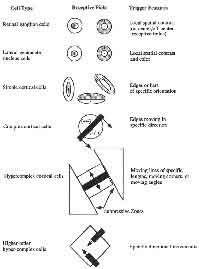 Figure
5-26a Representative
Figure
5-26a Representative
Visual Stimuli
along
the visual pathway
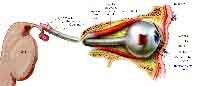
Figure
5-26b Representative
Visual Stimuli
along
the visual pathway
|
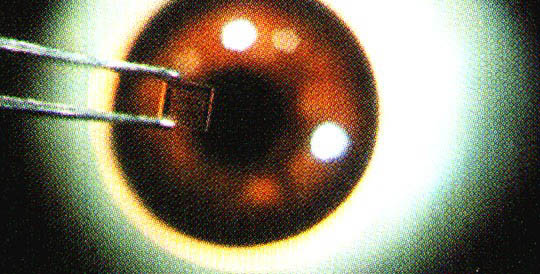
In Figure 5.26c
retinal implant is shown in front of eye. This retinal implant,
developed in Germany, is made up of a series of sensors and LEDs to
replicate a very crude image and projected it onto the retina. With the
new emphasis on MEMS technology, there are many different approaches to
a retinal implant. This particular implant would only give very crude
sight over a limited angular field of view, where the total number of
pixels would probably be < 1 percent of the total in a normal
healthy eye.
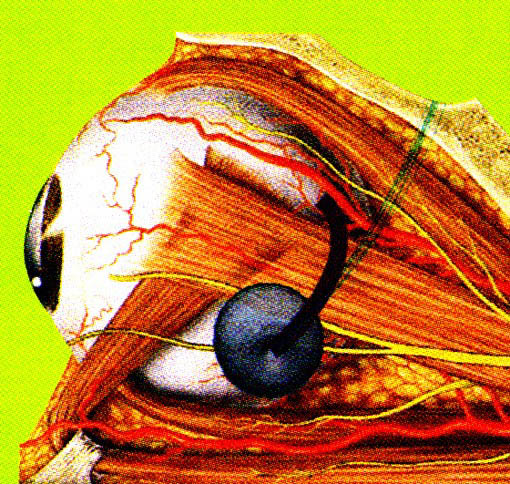
In Figure 5.26d
retinal implant is shown relative to Eye. Small
Times is a new publication
devoted to MEMS technology. Using MEMS technology is possible to
configure a variety of retinal implants. This implant is designed to
stimulate nerve cells and improve vision through time release of a
drug. Again, the present state of technology cannot provide a
high-resolution image that can presently be integrated with the optic
nerve. There are other approaches being developed, but some of the best
approaches may be to aid the present eye structure. |
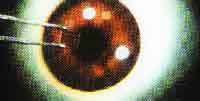 Figure 5.26c Retinal implant Shown in front of
eye (page 9, Optics
and Photonics News,
Figure 5.26c Retinal implant Shown in front of
eye (page 9, Optics
and Photonics News,
Jan., 2002)
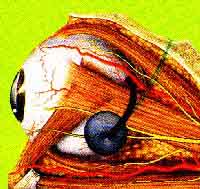 Figure 5.26d Retinal Implant shown relative
to Eye
Figure 5.26d Retinal Implant shown relative
to Eye
(page 55, Small Times,
Nov./December 2001)
|
|
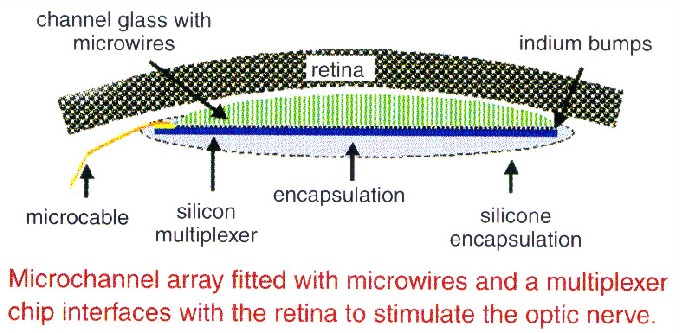
Figure 5.26e shows a
potential new retina implant that may help the millions of people that
have blindness from degeneration of the photoreceptors in the retina.
Optobionics has a wireless scheme of connecting and interfacing to
implanted vision devices in the retina. The micro channel glass array
matrix contains millions of micro wires implanted between a multiplexer
and the retina. DARPA, universities, and other groups have also been
active in this field. For some of these concepts, scanned images are
introduced to the implant from an outside camera device.(reference:
SPIE OE Magazine, July 2002, page 10)
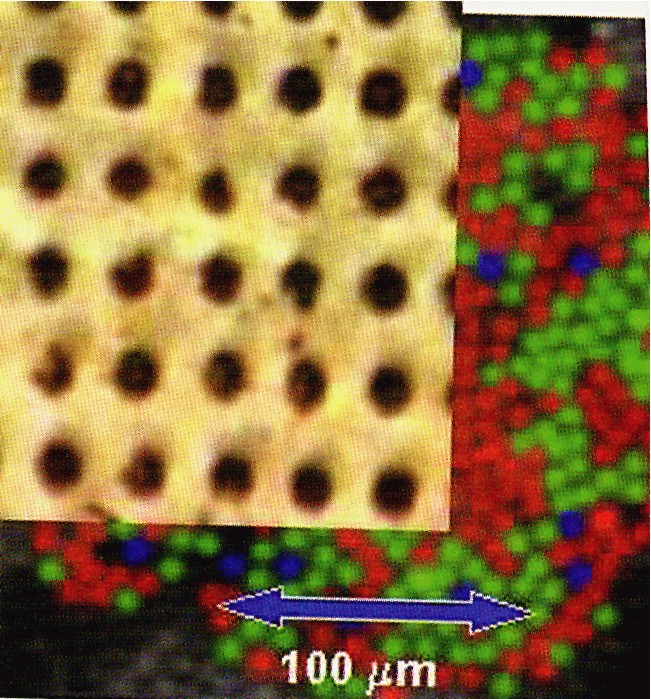
Figure 5.26f shows
the relative resolution of a ceramic micro detector for an implant as
compared to human cones of the retina shown in the background. One can
see the resolution is not real great, but for the million peoples that
are afflicted with macular degeneration, this could be a great
improvement of sight. Here ceramic photocells that mimic the function
rods and cones are expected to absorb light and generate a photo
voltage to fire the neuron cells. |
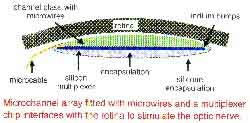 Figure
3.26e Potential Retina Implant.
Figure
3.26e Potential Retina Implant.
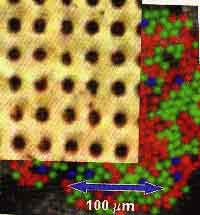 Figure
5.26f Retina Implant Resolution.
Figure
5.26f Retina Implant Resolution.
|
Several different
groups are working on various methods of providing implants into the
retina. The implant needs to be biocompatible and stable. Human trials
are expected to begin in 2003. (reference: Biophotonics International,
April 2002, page 26)
Second Sight was
founded in 1998 to create a limited retinal prosthesis to provide sight
to blinded patients. By mid 2003 they have developed, built, and
implanted a simple visual prosthetics to enable blind individuals to
achieve greater independence by seeing 16 pixels of information at one
time. They are currently developing more advanced implantable devices
with more pixels that use power and data from an external camera and
electrically stimulates the retina through an array of electrodes.
Further, research conducted by Second Sight has shown that more
advanced array designs with more pixels are possible. This will
significantly improve the quality of the images seen by patients. In
his 2000 State of the Union Address, President Clinton referred
specifically to Second Sight's research,
"Scientists are also
working on an artificial retina to help many blind people see.".
Second Sight is
conducting one FDA approved device study and has approval for another.
If someone you know is interested in participating in one of these
trials, please go to their web page for additional information.
Patients eligible for consideration are those with a confirmed history
of retinal degenerative disease in the worse-seeing eye with remaining
vision no better than light perception (see links section).
Second Sight received
FDA approval to conduct clinical trials to evaluate the feasibility of
using electrodes to provide electrical stimulation of the retina to
elicit visual percepts in blind subjects. In the early study the device
was removed at the end of the test. The longer-term clinical trial is
to evaluate the feasibility of utilizing a retinal stimulation system
(Reference:
Second Sight Web site
and LINK Conference).
D. Integration of man's
technology with
biological eyes.
By applying millions of hours
of design, using today's technology on new vision systems, scientists
are evolving sensors that will have similar vision to some natural
eyes. Early, relatively crude experiments have been done when very
low-resolution imaging has occurred. It is not expected that they will
ever equal the total capability of human eyes in the area of healing
and reproduction. This technology may aid us in treating nature's
eyes.
Natural healing
features of eyes may also be accelerated through application of new
medical technology to provide alternative answers to vision problems.
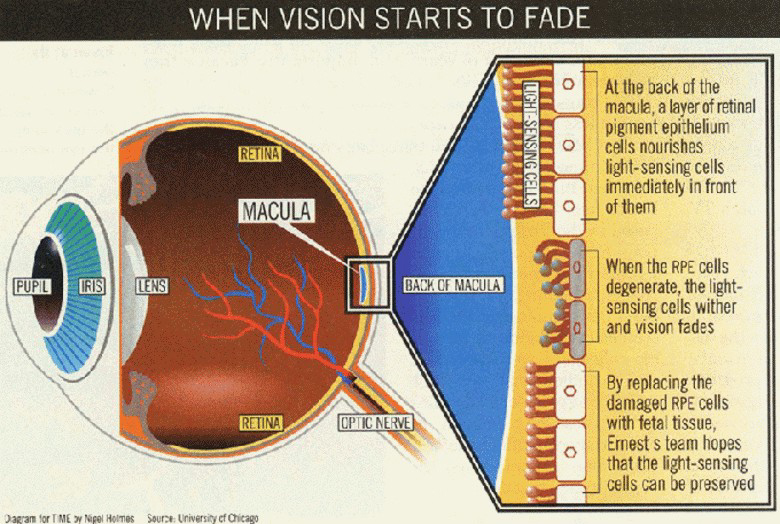
The following figure illustrates one way that vision may be improved by
cell replacement. This is very controversial because of the use of
fetal tissue. (Pg. 26, Time,
Fall, 1997, J. Madeleine Nash}
Just getting eyes, or even
parts of eyes to reproduce or repair, is still a major mystery. DNA
codes couldprovide clues to future development of accelerated repair or
growth of specific flawed parts of eyes. This will require discovery of
a means of understanding how original DNA plans are
implanted, then using the built-in chemical manufacturing capabilities
to generate the specific cells at the location needed for repair. Cell
communication is expected to be necessary to provide some means of
controlled internal repair. This will require advances of biological
and other sciences to determine the communication necessary for working
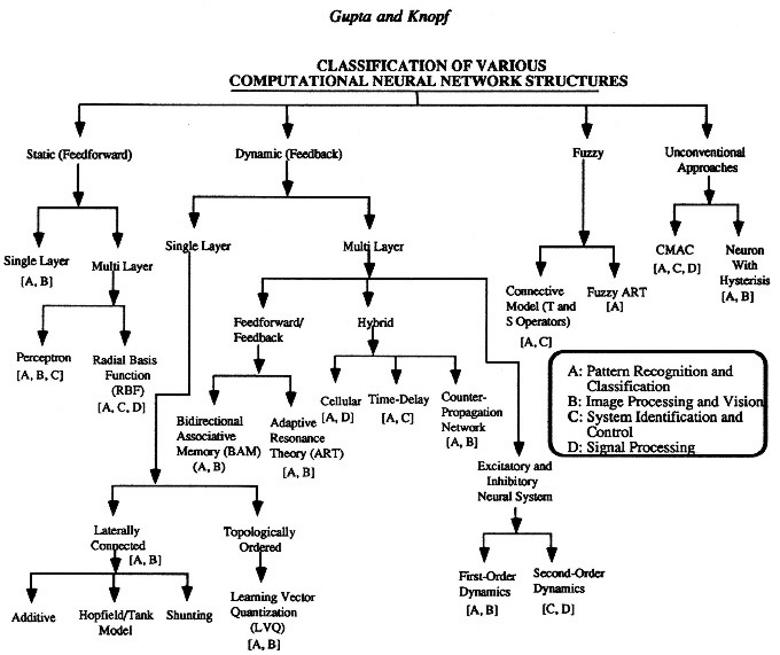
with each particular type of cell. For example Figure 5-28 is a
classification of possible neural networks that are possible from what
we are learning about vision systems. |
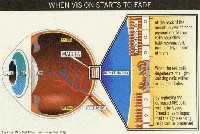 Figure
5-27 Cell
Figure
5-27 Cell
Replacement Concept
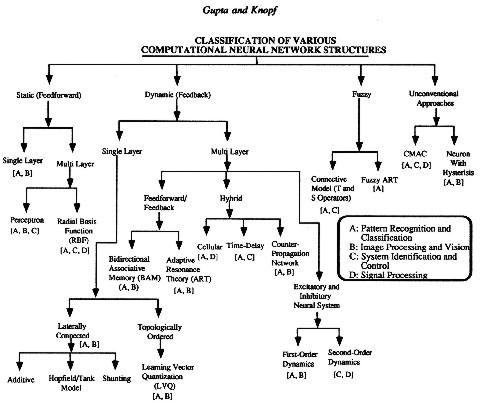 Figure
5-28 Neural network
Figure
5-28 Neural network
structures that
have possible
applications to
vision
(Pg. 22, Gupta and Knopf, IEEE
Neuro-Vision Systems IEEE Press,
1993)
|
Even though building simple
artificial eye optical
systems may be feasible, the process of interfacing artificial eyes to
a brain is expected to be far more difficult than actually building the
optics, sensors, and processing electronics for input to the eyes.
There
will also be considerable cost to manufacture and integrate new vision
aids for eyes. Naturally, use of as many of existing components should
be used. For example, if a brighter image is put on the retina then the
integration process is much easier.
Cell interface complexity
multiples with some
eye sensor cells having different communication channels than others.
There
is a greater possibility to encourage the repair of specific parts of
an
eye from its master plan, than to reproduce whole eyes in a test tube,
and then transplant them. For example, certain herbs, drugs and light
can
aid the healing process within the eye. Because of the interfacing with
cells, it would seem more likely to encourage new cells to grow into
their
correct locations. New communication development has to take place for
this to happen. More research is needed to define the total visual
process
in terms of the DNA structure.
Here we have researched some
of the wide variety
of eye designs. It is exciting to see the beginning of a merger of
man's
artificial and nature's living eye designs such as using laser implants
in eyes to transmit data from a camera to an artificial retina segment.
This merger infers intelligent design, even to replace an existing lens
or group of sensors with artificial ones that can improve poor vision.
|
|